


Jellyfin, the local media server solution that makes people forget that Plex even exists, is going through a major shakeup in its development team's organizational structure.
In a forum post published a few days ago, founder Joshua Boniface confirmed that he is departing as Project Leader, while Anthony Lavado is stepping down as a core team member.
Their exit comes just days after the other founder, Andrew Rabert, announced his own voluntary departure.
Joshua and Anthony describe their exit as being amicable, saying that there is little to no risk of a hostile fork. They're leaving day-to-day operations to the rest of the team, many of whom have already been managing different parts of Jellyfin for years.
The departures

Joshua and Andrew leaving are both cases of maintainer burnout. Boniface says he could no longer give the role the mental or time-based effort it demanded and that he was facing real risks to his own mental health as a result.
Rabert's account, shared in a GitHub issue about renaming his now-independent desktop client project, points to something similar. He said he started rewriting Jellyfin's desktop client back in December 2025 but ran into resistance from certain members of the Jellyfin organization over how he was approaching the work.
That friction eventually cost him his motivation, and he made the call to leave the Jellyfin organization.
Anthony's departure is a bit different. He said he hasn't touched much code in recent times, focusing instead on backend tasks like App Store management, and that changes in his personal life mean he can no longer give Jellyfin the time he used to.
He's still sticking around through the transition, though, and says he's committed to making it a smooth one even if it takes up to a year.
Things were looking up!
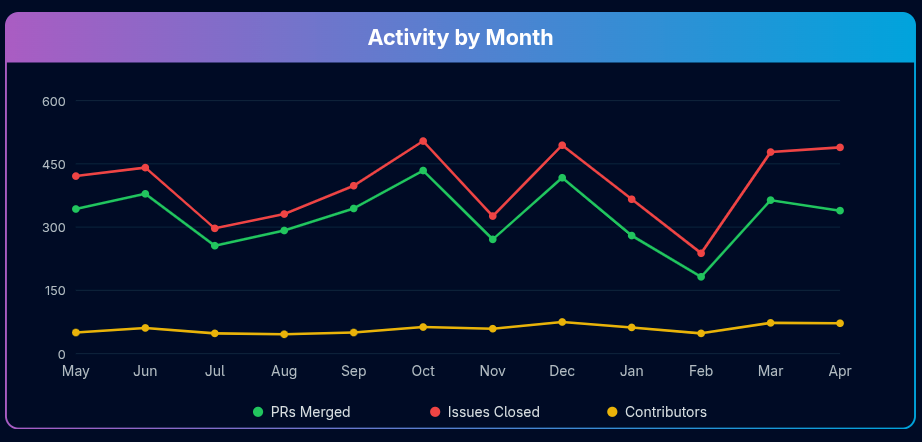
It wasn't long ago that Jellyfin looked to be in a good spot. Back in May, the project published a State of the Fin update, and the stats pointed to a project running at a healthy pace.
The accompanying activity graph, covering May 2025 through April 2026, showed PRs merged and issues closed staying in the hundreds nearly every month, with PRs merged ranging from roughly 180 to 430 and issues closed from roughly 240 to 500. The contributor count held steady throughout.
That same post introduced Jellyfin's LLM and AI policy, put together in response to a wave of AI-authored pull requests that had piled onto the team's workload.
It also included a section titled "Burnout / Remember the Person", where the team said that growing support demands and the extra review work brought on by AI-generated code had worn down staff across development and admin roles.
If you draw a parallel from the departures above, it is clear that many people were/are running at the absolute limit or have broken past their capacity to deliver good work.
And this is not something new; we are used to hearing about maintainer burnout taking capable devs off projects they once used to have a passion for. While things are certainly improving thanks to increased awareness, there's still a long way to go.
Suggested Read 📖: You can set up Jellyfin on a Raspberry Pi to host your media library locally.
 Abhishek Kumar
Enjoyed this update? Support independent Linux news coverage
It's FOSS has been helping people use Linux for the past 14 years. Help us stay independent from big tech. Become a Plus member, enjoy ad-free reading and get 5 eBooks.