


Rune has left behind its proprietary old self for a new open source identity under the GPLv3, letting you clone, read, or build off it from GitHub. The relicensing came via a string of moves, one of which was the commit that marked the project's license transition.
The developers have also decided to keep commit history mostly intact, which runs back to 2017, with some gaps here and there. I point that out because projects that go open often squash the history first, so old secrets and sensitive commits never land in the public repo.
To give you some context, Rune is an IDE for Linux and macOS that can be used for writing and debugging code, running your terminals and CLI tools in the same window, and letting a coding agent take on parts of your tasks.
It is based on Go, and the team defends its use by showcasing vtebench runs that show the Go terminal keeping pace with Alacritty, Ghostty, and Kitty on a set of terminal workloads.
Do keep in mind that these were not language benchmarks; these only show how far the IDE has come.
The Rune team is further looking to expand language support beyond Go and Python, with Rust and Zig already in beta on main and an open call for developers to steward their own language.
While the IDE itself is free to use, people can opt for paid plans to get access to the P2P Rune Network, premium support, and a separate tailored plan for enterprises with extra bells and whistles.
Going the open source route
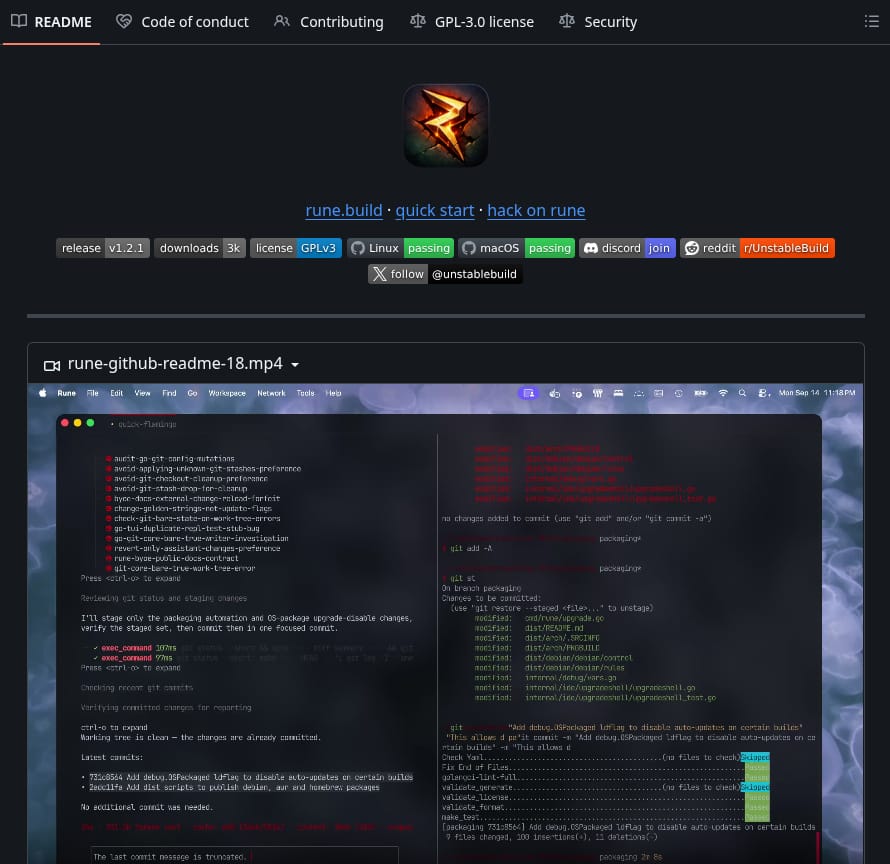
The license, GPLV3, allows contributors to keep the copyright in what they submit, and the company (Unstable Build LLC) takes no special right to relicense their work. Earlier, the project asked contributors to sign a CLA; that's not the case anymore.
Rune's creator, Ernest Romero Climent, is not happy with what has happened elsewhere in open source, where companies build in the open, lean on the community for years, then change the license once the project is worth something.
Instead, they are looking to pay contributors via an opt-in credits program, where accepted work earns credits and a slice of eligible service revenue funds a pool, which is then split by the credits each contributor holds.
All awarded credits will be tracked in a public ledger, showing the revenue behind the pool, any deductions, the credits awarded, and how each payout is worked out.
As I said, all of that is optional. You can still send patches without joining the program.
Suggested Read 📖: openEuler and the race to build Asia's AI infrastructure.
 Edmar Pereira
Enjoyed this update? Support independent Linux news coverage
It's FOSS has been helping people use Linux for the past 14 years. Help us stay independent from big tech. Become a Plus member, enjoy ad-free reading and get 5 eBooks.
Skip the AI slop and SEO spam in your Google results
Tell Google you prefer It's FOSS, and it will show our Linux news and tutorials, created by experienced Linux users, more often when you search. It takes just a click.
Set as preferred sourceGet FOSS Weekly in your inbox