


The big Linux desktop environments have largely made up their minds about Wayland.
GNOME finished removing X11 from its login manager in March, and last month, KDE Plasma retired support for starting X11 sessions. Cinnamon is a step behind, but Linux Mint 27, due around Christmas, is set to ship a Wayland session that is no longer experimental. Though X11 stays the default.
Smaller desktops are at different points on the same journey.
LXQt dropped the experimental label from its Wayland session in v2.3.0, and Budgie in the Ubuntu Budgie 26.04 release went Wayland-only with labwc.
MATE, on the other hand, has moved in bits and pieces. Since MATE 1.26, apps like Atril, System Monitor, Pluma, and Terminal can run on Wayland, while the official mate-wayland-session is a simple, experimental setup that relies on Wayfire.
What's still missing is a Wayland-native window manager for MATE. Its own, Marco, has no Wayland mode, and the following two projects, Polo and MATE Wayland Desktop, now aim to replace it in different ways.
Polo
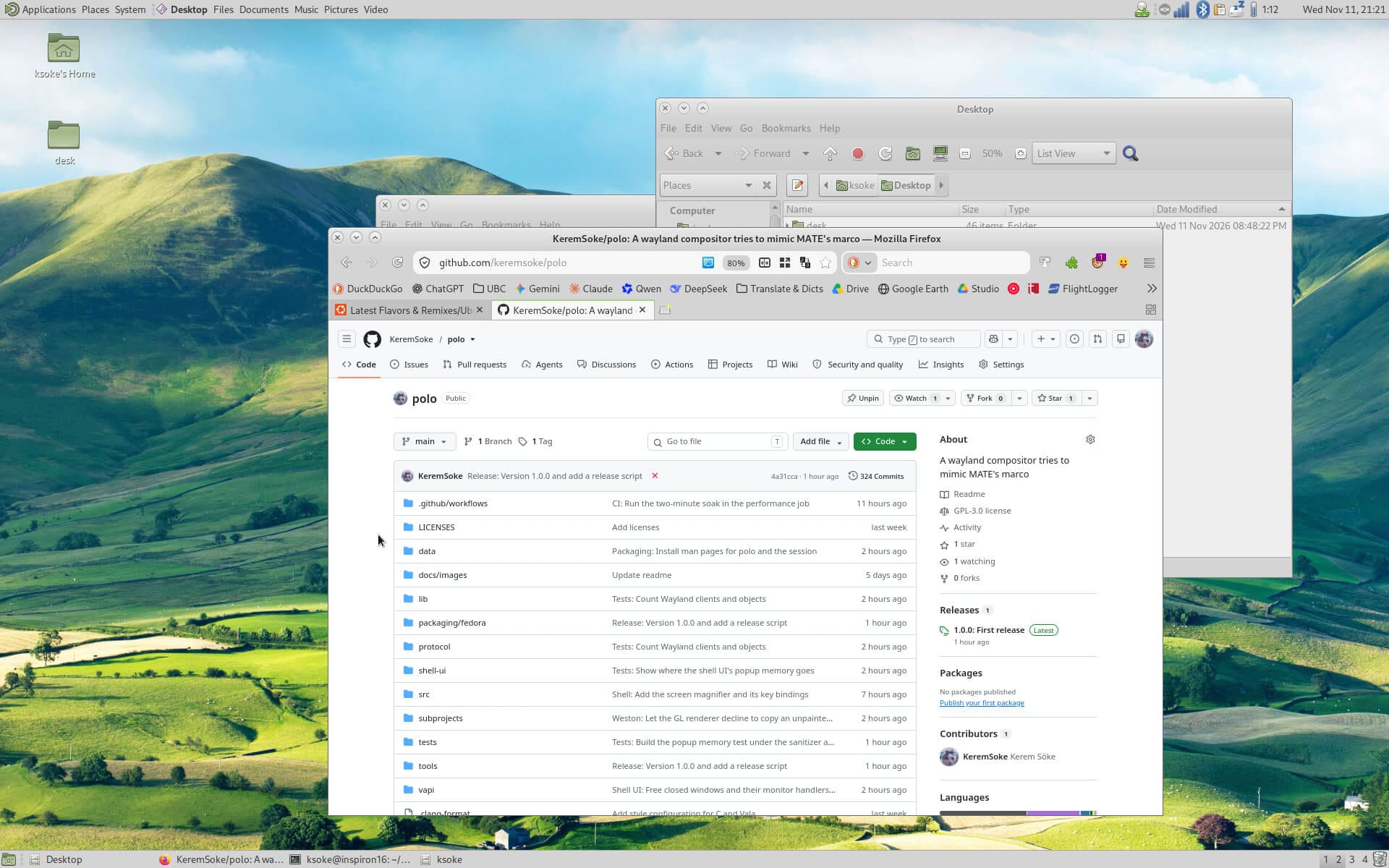
Polo comes from developer Kerem Söke, and it is a compositor, window manager, and session manager for people who want MATE to look and behave on Wayland the way it does today.
It is written in Vala and C on top of libweston 16, follows Marco's window management rules, and retains the settings, themes, and keybindings MATE users already have. Apps that still need X11 get a window manager of their own under XWayland.
Polo handles the session too, using the D-Bus interface of mate-session-manager, and the panel, Caja, and the screensaver can talk to it as they would on X11.
It's first stable release was published on 12 November with support for tiling, workspaces, screen sharing through xdg-desktop-portal, and layer shell compatibility for mate-panel.
A DRM backend is responsible for handling multiple monitors and remembering screen layouts. Effects like wobbly windows and a desktop cube are also included (fans of Compiz, rejoice!).
You can build Polo from source on Fedora 44 or 45, Debian 14, or Ubuntu 26.04 or 26.10. Once installed, a "MATE (Polo)" entry should show up in LightDM.
Kerem has also said that he may host his own .deb repository if the Debian and Ubuntu MATE teams do not ship Wayland-enabled packages.
MATE Wayland Desktop
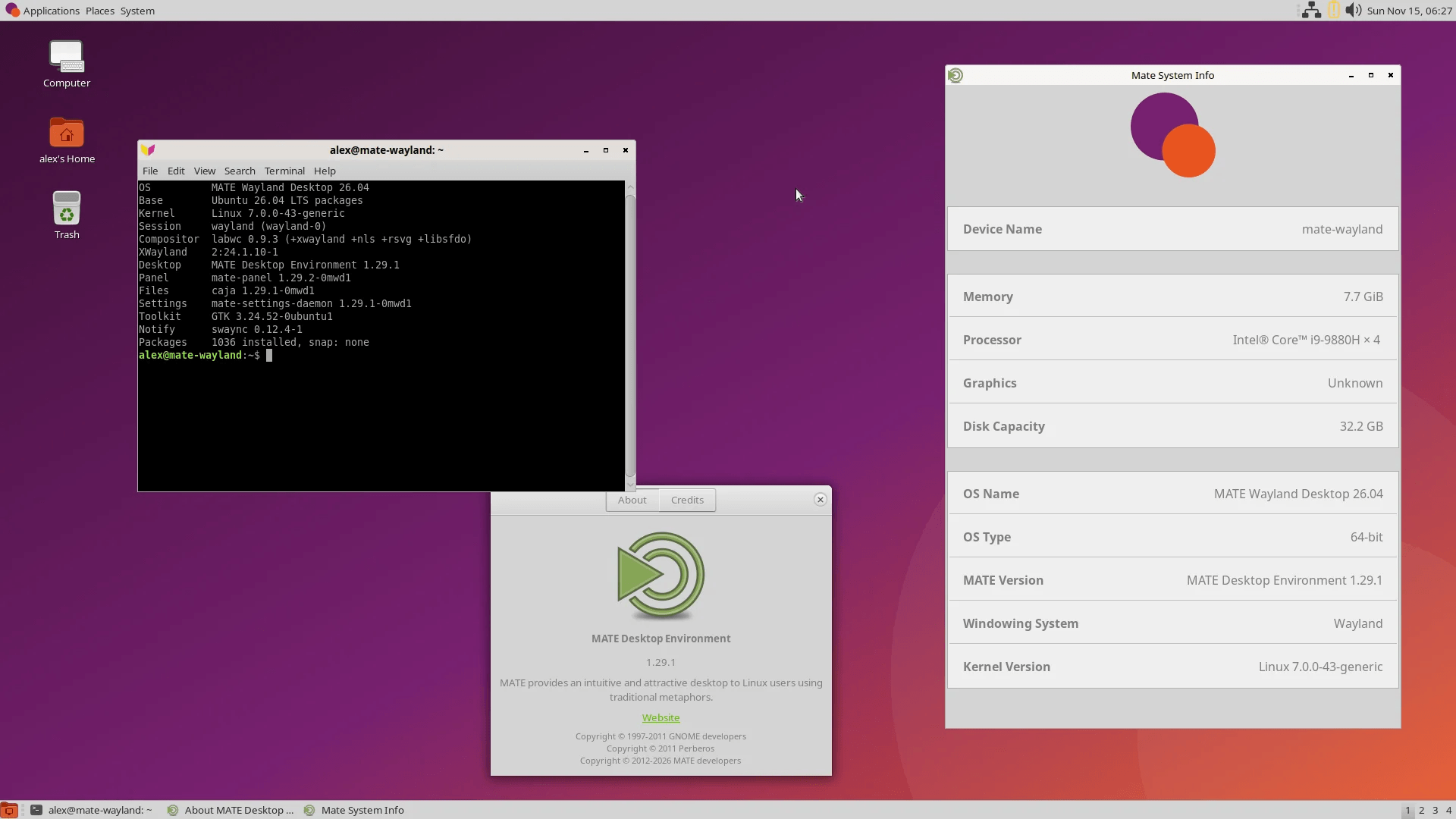
MATE Wayland Desktop uses an existing compositor instead of writing one. It swaps Marco for labwc and ships as an installable ISO built on Ubuntu 26.04 LTS, with Linux 7.0 and MATE 1.29 components as the foundations.
Eight of those MATE packages are rebuilt from newer upstream code, and one of them is mate-panel 1.29.2 with Wayland support turned on. Apps that only speak X11 run through XWayland.
Installation is handled by Calamares, and it offers optional LUKS2 full-disk encryption.
The project is also clear about the rough edges in it.
The keyboard, mouse, and keyboard shortcuts panels in Control Center crash when running natively, so MATE Wayland Desktop opens them through XWayland instead.
MATE's own Displays dialog does not work on Wayland either. The "Displays" entry in the launcher opens wdisplays instead.
During installation and usage, Secure Boot has to be off, and the ISO boots up with the open source Nouveau GPU driver. NVIDIA's own driver can be installed afterward with ubuntu-drivers.
Seeing that this is a new offering, I highly recommend you test it on a spare machine before going for a full installation.
You can get started with its ISO on x86_64 systems by heading over to the official download portal.
💬 Well, are you excited about Wayland coming to MATE? Couldn't be bothered? Let me know below!
Enjoyed this update? Support independent Linux news coverage
It's FOSS has been helping people use Linux for the past 14 years. Help us stay independent from big tech. Become a Plus member, enjoy ad-free reading and get 5 eBooks.
Skip the AI slop and SEO spam in your Google results
Tell Google you prefer It's FOSS, and it will show our Linux news and tutorials, created by experienced Linux users, more often when you search. It takes just a click.
Set as preferred sourceGet FOSS Weekly in your inbox