


That's very interesting to see considering OpenSearch began as a fork.
When Elastic relicensed Elasticsearch and Kibana in 2021, AWS built an open alternative, keeping it under the Apache 2.0 license. Three years later, the project moved to neutral governance after the Linux Foundation launched the OpenSearch Software Foundation in September 2024 as its vendor-neutral steward.
Now, reflecting on the journey so far, Linux Foundation Research and the OpenSearch Software Foundation have jointly published The 2026 Open Data Infrastructure Report, examining how organizations are building out data infrastructure and what role OpenSearch plays in that picture.
The survey, conducted in May 2026, covered 294 respondents across diverse categories like IT vendors, end-user organizations, and independent consultants.
The report, briefly
Generative AI and LLM-powered applications lead all AI use cases at 82% of organizations surveyed.
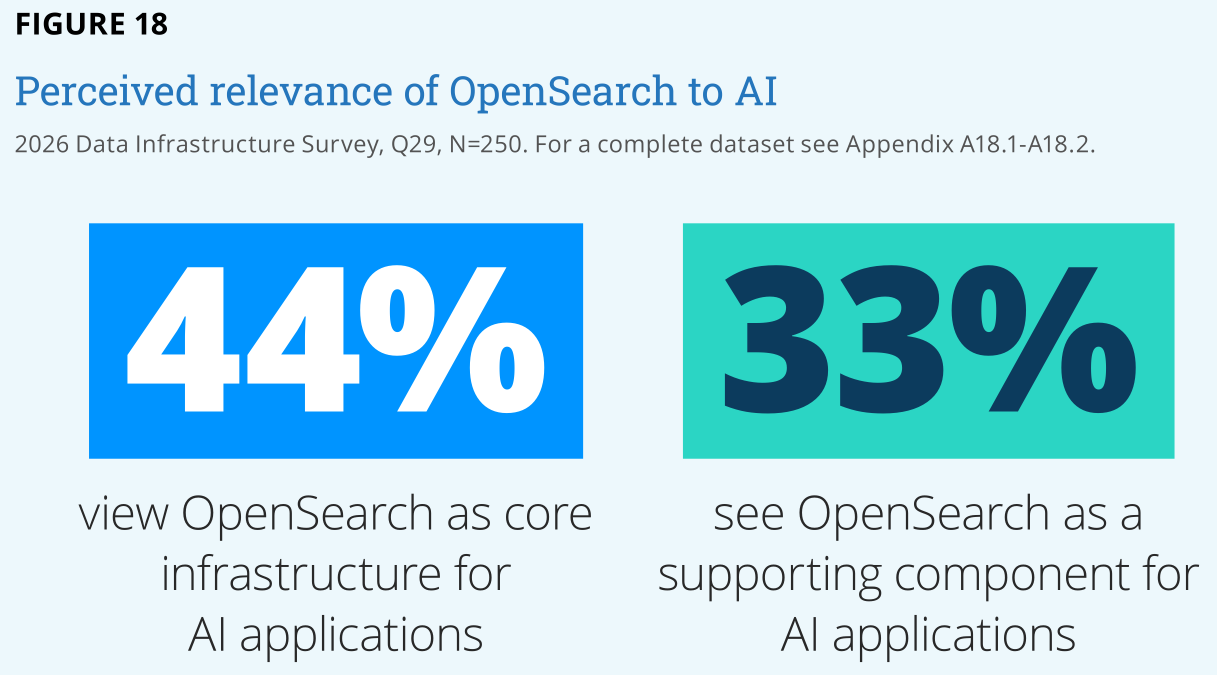
At least 83% of respondents across every region are already running AI workloads or have plans to. Among current OpenSearch users, 62% are already using it in AI workloads, and 44% consider it core AI infrastructure rather than a supporting component.
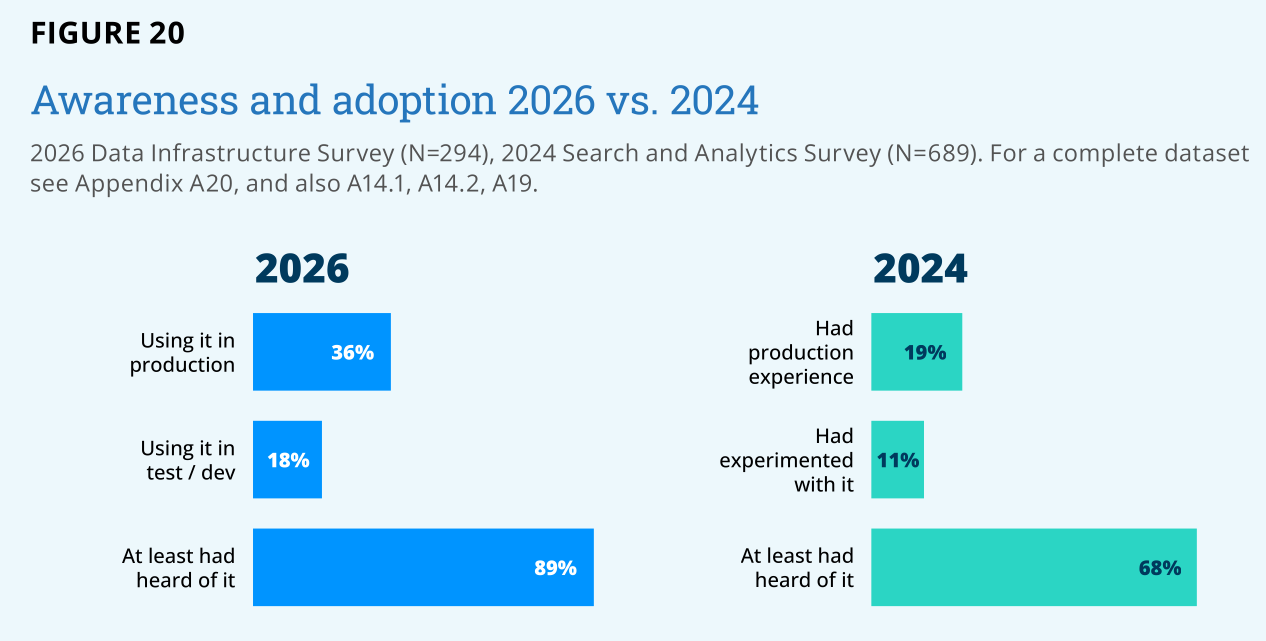
By 2026, 89% of organizations had heard of OpenSearch, up from 68% two years prior. Production deployments went from 19% to 36% over the same period, with another 36% running tests or assessing adoption.
Cost and vendor independence are what organizations weigh most when picking a data infrastructure platform. Total cost of ownership tops the selection criteria for 80% of organizations, security and compliance for 79%, and vendor independence for 69%.
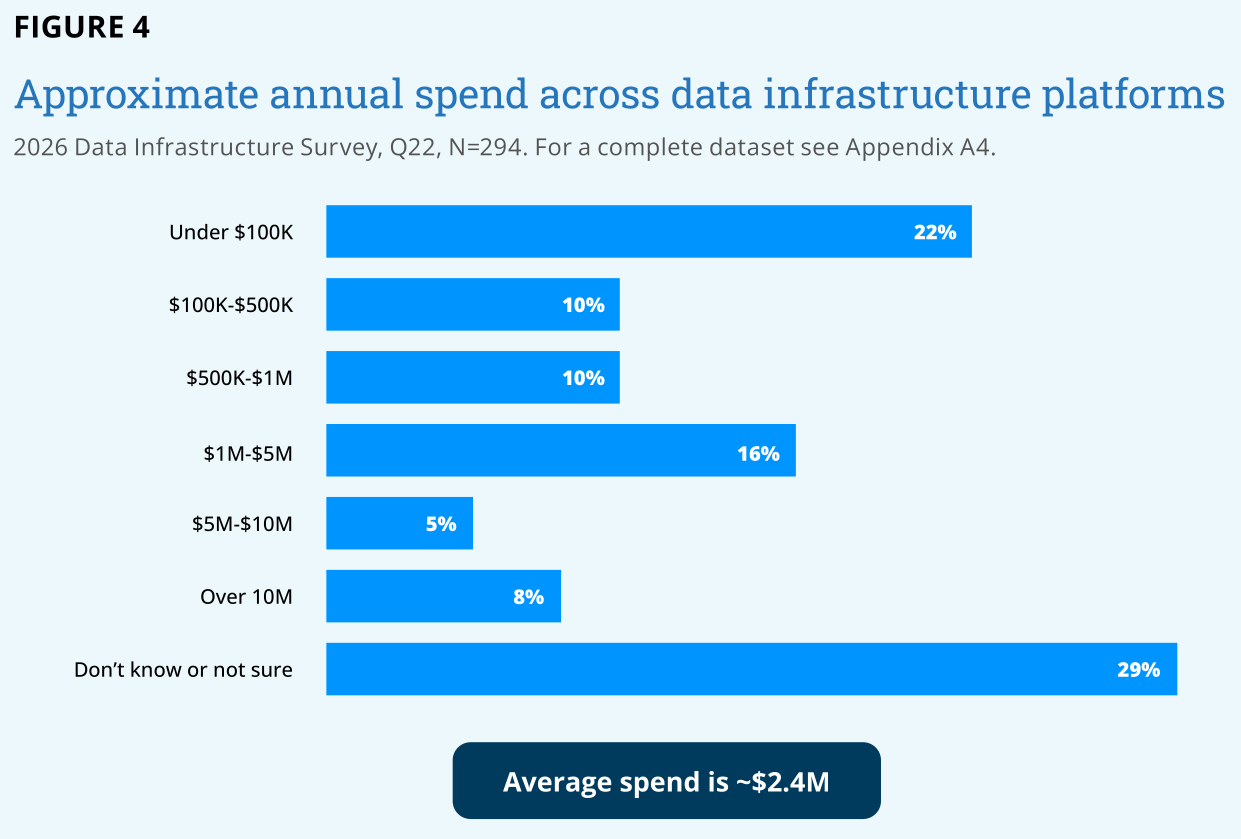
71% also say running infrastructure outside any single cloud provider's control is a strategic priority for their organization, while average annual data infrastructure spend across the sample sits at around $2.4 million.
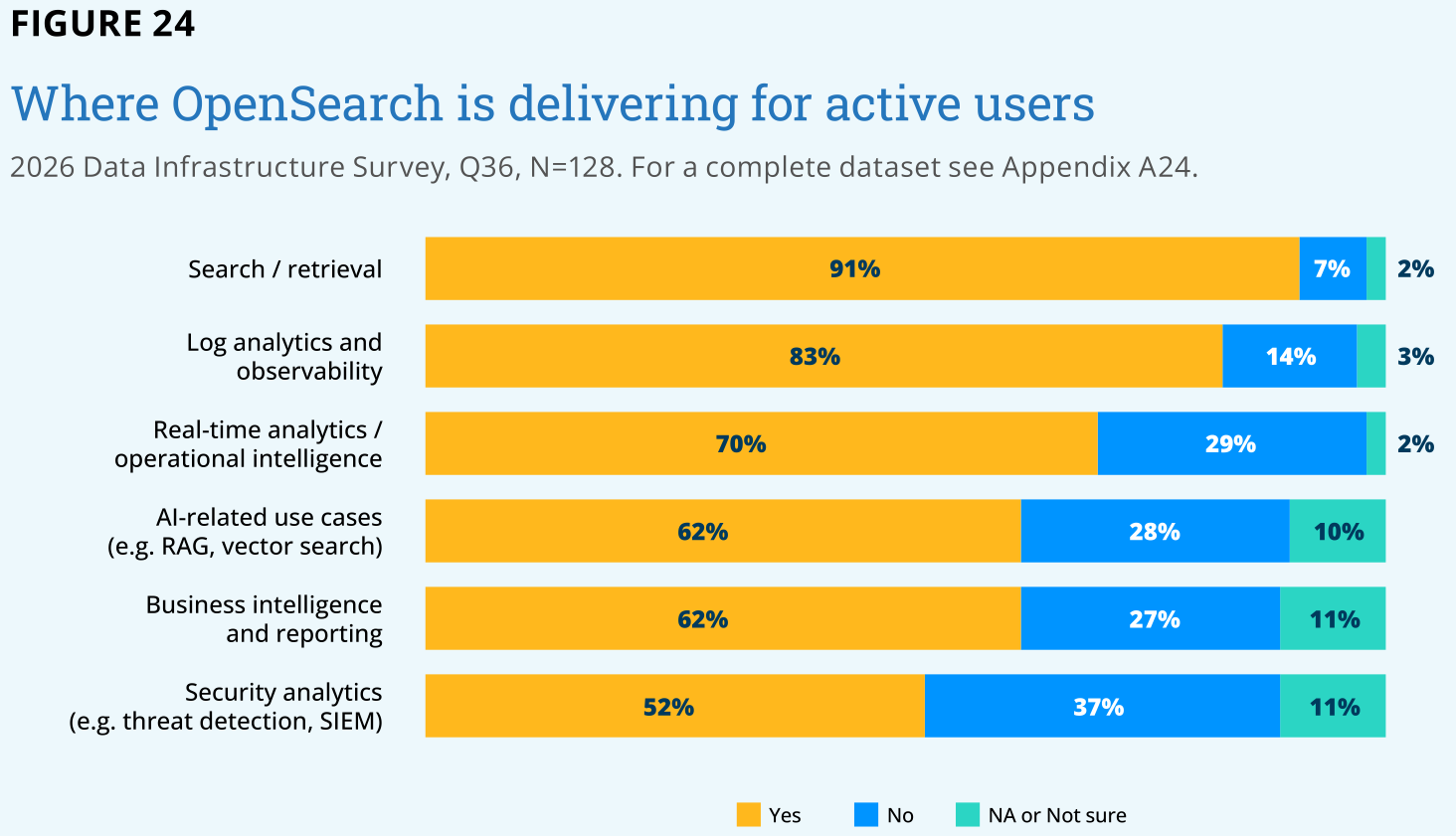
Among active users, search and retrieval leads at 91%, followed by log analytics and observability at 83%, real-time analytics at 70%, and AI-related workloads at 62%.
Whereas hybrid search is the go-to approach for 68% of organizations.
What now?
Most current deployments are not yet deeply embedded. Six in ten users say their OpenSearch setup is either experimental or something they could swap out; only 36% call it deeply embedded or mission-critical.
Among non-users, 81% say they are open to evaluating OpenSearch, though only 14% are actively planning to do so.
Alongside the report, the OpenSearch Software Foundation has announced three new members; one of them being Intel, and the other two being the new long-term support vendors.
We asked Bianca Lewis, Executive Director of the OpenSearch Foundation, what she thought about where agentic AI's headed next and how OpenSearch would fit into it:
The technology stack powering agentic AI is shifting rapidly, and with growing uncertainty around AI costs, long-term commitments to proprietary platforms present both a financial and architectural risk. Now, leaders are turning to an open, vendor-neutral platform to strategically mitigate risk.
An open data layer provides cost data and full visibility into which services are being called, giving teams the clarity needed to accurately cost and manage their infrastructure.
This delivers the flexibility to innovate without vendor lock-in, ensuring organizations maintain sovereignty over both their data and their spend as the future of AI takes shape.
Enjoyed this update? Support independent Linux news coverage
It's FOSS has been helping people use Linux for the past 14 years. Help us stay independent from big tech. Become a Plus member, enjoy ad-free reading and get 5 eBooks.