


Most Linux distributions are still figuring out where AI fits. Some are even blocking AI-based contributions while others are shipping AI tools in the system itself.
openEuler is doing something more comprehensive. It is embracing AI completely. From its development workflow to the operating system it offers to end users, AI is omnipresent. The aim is to move towards an AI-first ecosystem to give users an "AgentOS".
The project is putting AI into three places at once: the community's own plumbing, the workstation you develop on, and the operating system itself (so that it can be used by AI agents and harness like OpenClaw and Hermes).
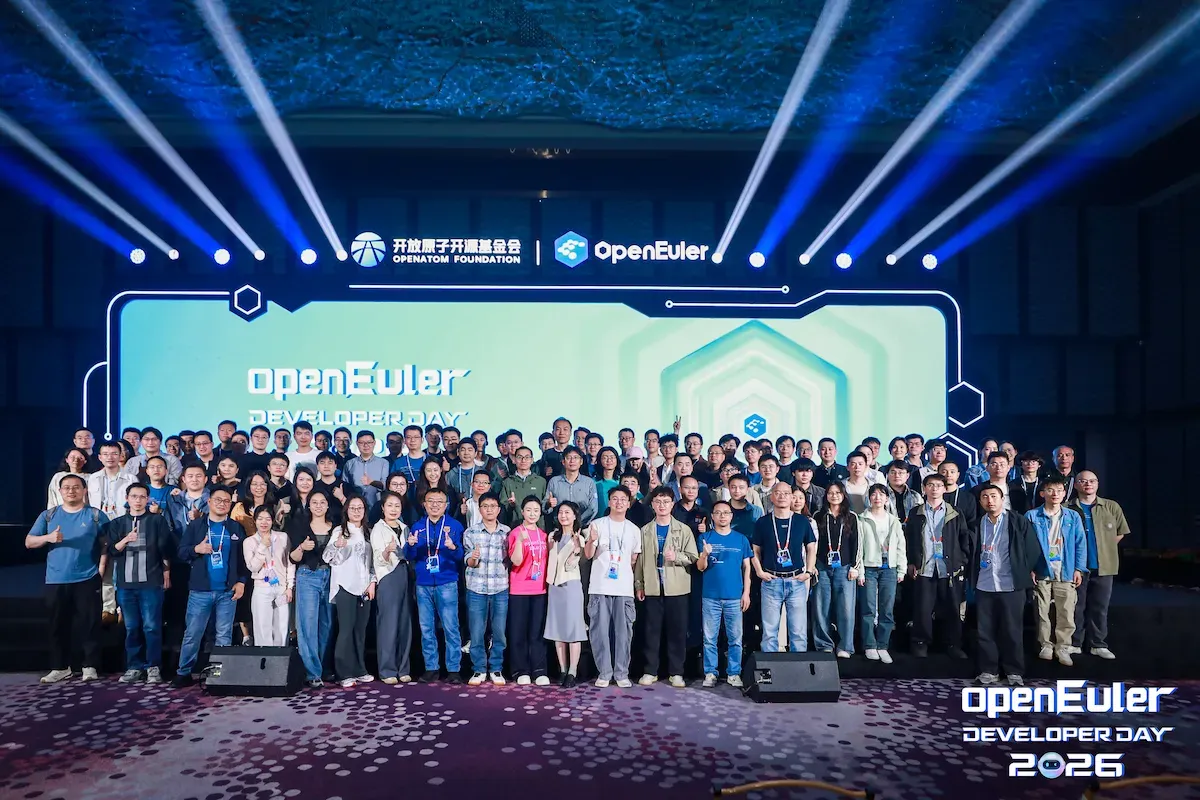
openEuler laid out this roadmap at its Developer Day 2026, and the focus is on improving developer experience (DX). That's a nice term to use, actually.
I haven't run any of this hands-on yet, so what follows comes from openEuler's material and public repositories. Feel free to check them out.
AI inside the community's own infrastructure
Before openEuler asks you to trust AI in your OS, it's putting AI to work on its own code. And I think this matters most for contributors, specially because it makes their job and life easier.
The openEuler community is adding AI-assisted review to its CI pipelines, starting with kernel patches. CI (continuous integration) builds and tests every patch before merging, so this means that AI checks on the code before a maintainer sees it. AI agents are also generating package spec files, the recipes that turn source code into RPM packages, which is exactly the tedious work that keeps new packagers away.
Vulnerability handling is where the work is most concrete. According to the community's April 2026 monthly report, the infrastructure SIG built a CVE repair agent team with 6 roles, from architect and reviewer to QA and a CI watcher.
It automates the path from parsing a CVE issue to submitting a fix PR, and when a build fails, it learns from the EulerMaker logs and updates its own rules. openEuler says this "significantly" shortened the repair cycle but hasn't shared figures.
MCP and agent infrastructure
The second piece is data. Community information is scattered across SIG pages, CVE advisories, and download mirrors. openEuler is using the Model Context Protocol, or MCP (an open standard that lets AI assistants call external tools and data), to give easier access to all this data.
The clearest example is the openEuler Portal MCP Server. Plug it into Claude Code, Cursor, or Cline, and you can ask "who maintains this SIG?" or "which CVEs affect this version?" in plain language.
Though the strategic focus is on where agents run. openEuler is building agentic sandboxes (isolated environments where an agent can execute code without touching the rest of your system) on a hardened security base. The goal is to give you a reliable place to run and operate agents, and we'll see how that works with Conch below.
A workstation that keeps up with AI
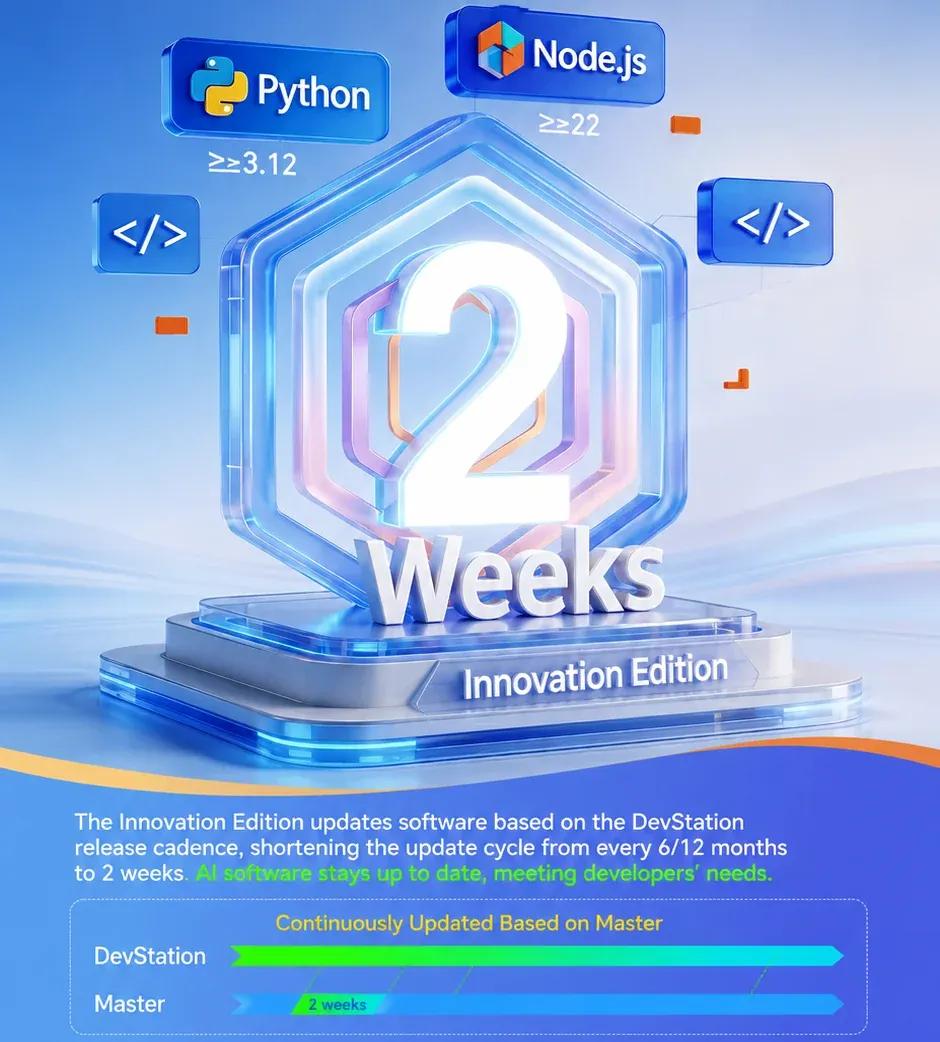
If you've tried running a recent AI agent on an enterprise distro, you probably have faced this problem. The agent wants Python 3.12 or Node.js 22, and your stable release ships something much older.
DevStation, openEuler's developer desktop, now has an 'Innovation Edition' to fix that. It tracks the master branch and pulls in updated software every 2 weeks instead of every 6 or 12 months, with Python 3.12+ and Node.js 22+ as the baseline.
It builds on what we covered earlier, when DevStation in openEuler 24.03 LTS SP4 shipped an MCP-based assistant that changes system settings from natural language. The idea now is broader: keep AI software perpetually updatable and make the community infrastructure friendly to both developers and agents.
Evolving toward AgentOS
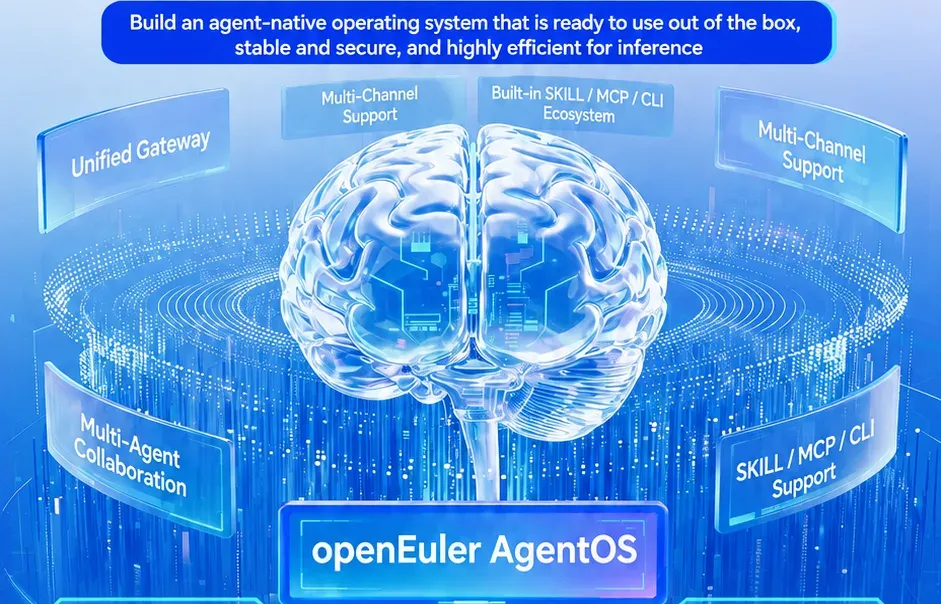
openEuler has started evolving toward AgentOS, blending AI directly with OS capabilities. Hu Xinwei, chairman of the openEuler Technical Committee, describes it as a "production-grade AgentOS" built to tackle usability, security, and cost.
It comes in layers: Agent App, Agent Service, and Agent Kernel. The app layer isn't a walled garden either, since openEuler's architecture lists Claude Code and OpenClaw alongside its own agents. So, you are not restricted for choices here.
There are four core capabilities.
1. An intelligent hub
You talk to AgentOS through the PolyMind GUI or a TUI in the terminal. It quickly pulls in community-grade skill modules.
openEuler also stresses that memory use stays low even on long-running tasks. The xiaoO repository, which calls itself "the intelligence hub of AgentOS," points to layered memory and context compression as the reason.
2. End-to-end security protection
AgentOS builds an active defense network on behavior analysis and eBPF monitoring. eBPF is a Linux kernel technology that lets small, verified programs watch file access, network calls, and process launches with very little overhead.
In practice, the OS watches what an agent actually does rather than trusting what it says it will do. For something that runs shell commands on your behalf, that's the right instinct.
3. The Conch sandbox engine
Conch gives each agent a strongly isolated place to run using lightweight virtual machines. According to an openEuler deep dive, it restores snapshots of the filesystem, VM memory, and VM state together, so a sandbox resumes from a saved point instead of booting from scratch.
That's how openEuler gets startup times on the order of 100 milliseconds. You get VM-level isolation at close to container speed, which is the trade-off every agent platform is chasing.
4. Extreme token-efficiency optimization
Tokens cost money and time, whether you pay an API provider or run models locally. openEuler offers one-click integration of acceleration components like X-LITE (a lightweight inference runtime from its GVirt project) and LMCache, which reuses the model's cached work on repeated context.
openEuler says these improve TTFT (time to first token, how long before the answer starts) and TPOT (time per output token, how fast it streams) by 20% to 30%. Agents make many model calls in a row, so those gains add up quickly.
openEuler is racing ahead with AI
If you contribute to openEuler (or any other distro), you'll feel the community-side AI first: AI review on kernel patches, generated spec files, and automated CVE fix PRs. Less manual work, and humans can still check what the agents submit.
If you need a cutting edge system for your AI agents, the DevStation Innovation Edition is the one to watch. A 2-week update cycle removes the most common reason to avoid an enterprise-grade distro for agent work.
AgentOS is interesting too. Sandboxing, eBPF monitoring, and token efficiency are the real problems anyone running agents in production hits. Conch, xiaoO, PolyMind, and the Portal MCP server are all publicly available on their respective repos.
Apart from being AI-native, openEuler is also doing the rather less fancy work of using AI on its own maintenance first. It will be worth watching for published numbers, especially CVE repair times and Conch in real workloads. Stay tuned for that.
Enjoyed this update? Support independent Linux news coverage
It's FOSS has been helping people use Linux for the past 14 years. Help us stay independent from big tech. Become a Plus member, enjoy ad-free reading and get 5 eBooks.