


Open source projects have mostly split into two camps on AI. Some keep a human in the loop, letting contributors use whatever tools they want as long as they take responsibility for the result.
Others have gone further and banned AI-generated contributions outright, no matter who reviews them. GCC has now weighed in, and it's leaning toward the stricter camp.
It's the compiler at the heart of building software across GNU and Linux systems, so its stance on AI carries weight well beyond its own repository. The GCC Steering Committee has decided to decline what it calls "legally significant" contributions made with AI, a term we will be unpacking shortly.
AI begone?
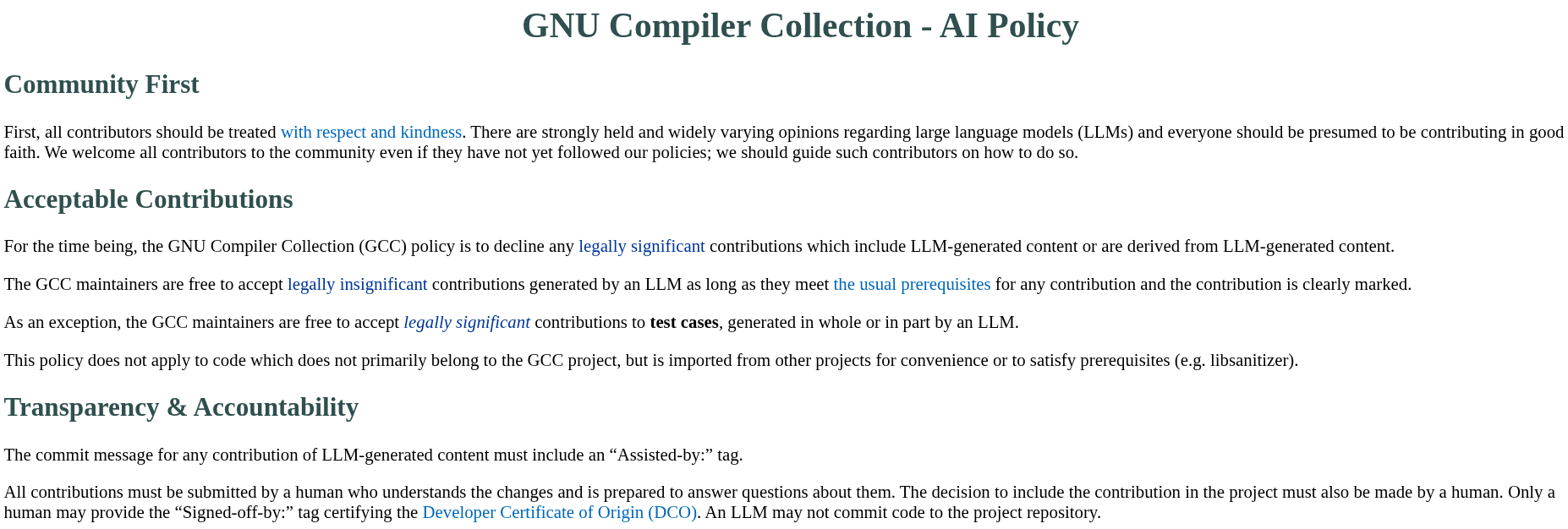
Well yes, and no. The GCC Steering Committee has inducted a new AI policy built around one core rule. If a contribution is legally significant and any part of it traces back to an LLM, GCC won't take it.
By that, they mean what the GNU maintainer guidelines define as being legally significant, which is around 15 lines of code or text, the point where copyright actually applies. Smaller edits don't count on their own, but enough of them from the same person can still add up to it.
There's some leeway for a certain use case, though. GCC maintainers can still accept legally insignificant AI-generated contributions, as long as they're clearly marked and meet the project's usual contribution standards.
Test cases are exempted too. Even ones that would normally count as legally significant can still be AI-generated. The policy itself only covers GCC. Any code imported from other projects for convenience or dependency satisfaction falls outside its scope.
Other than that, any AI-assisted contribution now needs an "Assisted-by:" tag in its commit message, similar to what the Linux kernel adopted earlier this year.
None of this touches how contributors use AI on their own time. Screen readers, translation tools, spelling and grammar help, research, bug hunting, and patch review are all fair game, provided the actual output submitted to GCC isn't AI-generated itself.
The GCC Steering Committee expects the policy to keep evolving, shaped by community feedback and wherever the wider GNU Project lands on AI overall. The next review is set for the start of 2027.
A growing trend
Codeberg took the dramatic route last week, where its members voted 358 to 144 to ban projects built mostly from AI-generated code and to formally rule out training AI models on user data or code.
They blame server strain from AI crawlers, climbing hardware costs, and a growing pile of low-effort AI-generated contributions as the driving forces behind the decision.
LLVM went the other way at the start of this year, adopting a "human in the loop" policy. Here, contributors can use any AI tool they like, but they have to disclose which one, answer questions about their submissions, and take full responsibility for the result.
GCC's policy lands closer to Codeberg's without going as far as an outright ban. Test cases keep a narrow opening that Codeberg's rules don't, and GCC still allows small, clearly marked AI contributions that Codeberg's project-level ban wouldn't.
Enjoyed this update? Support independent Linux news coverage
It's FOSS has been helping people use Linux for the past 14 years. Help us stay independent from big tech. Become a Plus member, enjoy ad-free reading and get 5 eBooks.
Skip the AI slop and SEO spam in your Google results
Tell Google you prefer It's FOSS, and it will show our Linux news and tutorials, created by experienced Linux users, more often when you search. It takes just a click.
Set as preferred sourceGet FOSS Weekly in your inbox