


Agent Name Service (ANS) now has a home at the Linux Foundation. The launch happened at KubeCon North America in Salt Lake City, and you might remember that the foundation first announced its plans for the project way back in June.
GoDaddy, Cloudflare, Salesforce, and DigiCert are among the organizations now involved with ANS, bringing the total number up to eleven.
One of the early deployments of ANS has been in AGNTCY, another project under the foundation, where its directory of AI agents can now check an agent’s ANS identity.
Announcing the move, Jim Zemlin, CEO of the Linux Foundation, had this to share:
Autonomous AI agents are transacting and operating across global systems, but they can't succeed without verifiable identity.
Under the neutral governance of the Linux Foundation, ANS provides a common foundation for trust that the entire industry can adopt, implement and improve together.
An explainer
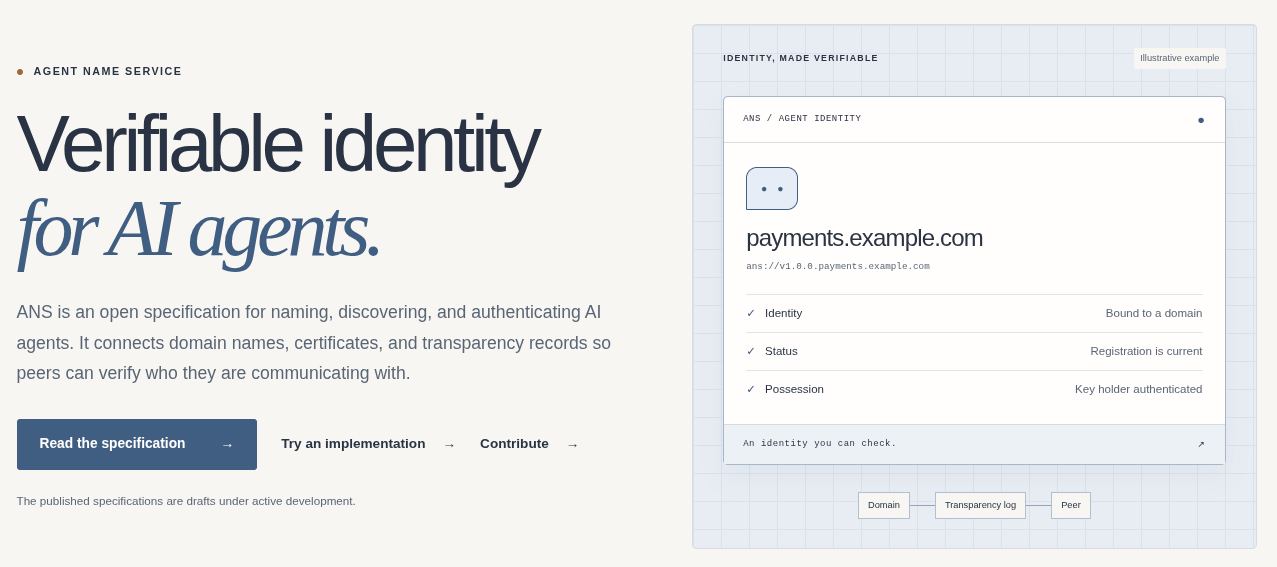
Platforms identify AI agents in their own ways, and a service that receives a request from one has no standardized way to confirm who the agent represents.
ANS tackles this by linking each agent to a domain name its operator owns, the same way a website is tied to its domain. Each version of an agent gets its own name, such as ans://v1.4.2.travel.example.com.
To register an agent, the operator first has to prove it controls that domain. Certificates are then issued for the agent, and every registration goes into a public log that anyone can read.
ANS also publishes details about each agent in DNS, the internet's address book, and other systems can then look them up with tools they already use.
The main DNS records use a format from a separate project called DNS-AID. ANS adds one record of its own that points to the agent's entry in the public log.
When an agent sends a request, the receiving system can check that its registration exists, that it has not been revoked, and that the agent really holds the key tied to it.
ANS only covers who the agent is. Deciding what it can do is left to the receiving system, and platforms have to add the check themselves.
The setup behind ANS
A technical steering committee now oversees the project. It starts with five seats, held by three people from GoDaddy, Ken Huang of DistributedApps.ai, and Michael Kantor of Hashgraph Online (HOL).
That lineup is only a starting point. The first election has to be held within 12 months, and after it, the charter prevents any one company from holding half or more of the seats (to ensure vendor neutrality, I assume).
The charter also mentions that meetings are meant to be open to the public and that discussions and decisions should be visible to everyone.
As for all the code in the project, the Go, Rust, and Java libraries currently use the MIT license, but new code contributed from now on has to use the Apache 2.0 license.
Some lore info
ANS began in 2025 as a draft sent to the IETF, the internet standards body, and a follow-up came in October. Drafts like these have no formal standing at the IETF and are not endorsed by it.
At present, the Linux Foundation calls the specification formalized. The reference code and a local demo are on the project's GitHub page, and the specifications are on ansinfo.ai.
Enjoyed this update? Support independent Linux news coverage
It's FOSS has been helping people use Linux for the past 14 years. Help us stay independent from big tech. Become a Plus member, enjoy ad-free reading and get 5 eBooks.
Skip the AI slop and SEO spam in your Google results
Tell Google you prefer It's FOSS, and it will show our Linux news and tutorials, created by experienced Linux users, more often when you search. It takes just a click.
Set as preferred sourceGet FOSS Weekly in your inbox