


Traditional operating systems are designed primarily to manage computing resources, including CPU scheduling, memory allocation, storage, networking, and application execution.
Agentic AI introduces another layer of complexity: infrastructure must also support the lifecycle of intelligent agents.
This includes agent deployment, task scheduling, execution isolation, context management, memory retrieval, tool invocation, observability, and recovery.
openEuler is embracing the shift toward agentic infrastructure and evolving its OS capabilities to support the development, deployment, execution, coordination, and optimization of agents across heterogeneous computing environments.
This is what they are discussing at the currently ongoing Agentic Infra OS Conference & openEuler Summit 2026.
AI Agents Need More Than Computing Power
AI agents are moving beyond conversation to execute code, call tools, interact with applications, and coordinate multi-step workflows. As these workloads scale, infrastructure faces a new set of challenges: secure execution, fast environment provisioning, efficient context reuse, persistent memory, and elastic resource management.
Traditional infrastructure was not designed around these requirements. The next evolution of the operating system must go beyond managing processes and hardware resources to support the full lifecycle of agent execution.
This is the direction behind openEuler's agentic OS: building an open, secure, and efficient software stack that connects operating system capabilities with agent runtimes, AI frameworks, data services, and heterogeneous computing resources.
The infrastructure is designed to operate across diverse computing architectures, including general-purpose processors such as x86, Arm, RISC-V, and LoongArch, as well as AI accelerators from multiple vendors. This heterogeneous approach is important because enterprise AI deployments rarely operate on a single hardware architecture or accelerator platform.
The architecture is centered on two layers: Agent Kernel, which provides foundational system-level capabilities, and Agent Service, which exposes reusable services such as secure sandboxing, memory, session management, and Tool Gateway. Around this foundation, complementary infrastructure technologies—including distributed caching and serverless data services—help support the performance, scalability, and data requirements of agent workloads.
Rather than placing every capability inside the OS kernel, the approach combines system-level optimization with reusable infrastructure services and an open ecosystem. Five technical pillars are central to this architecture.
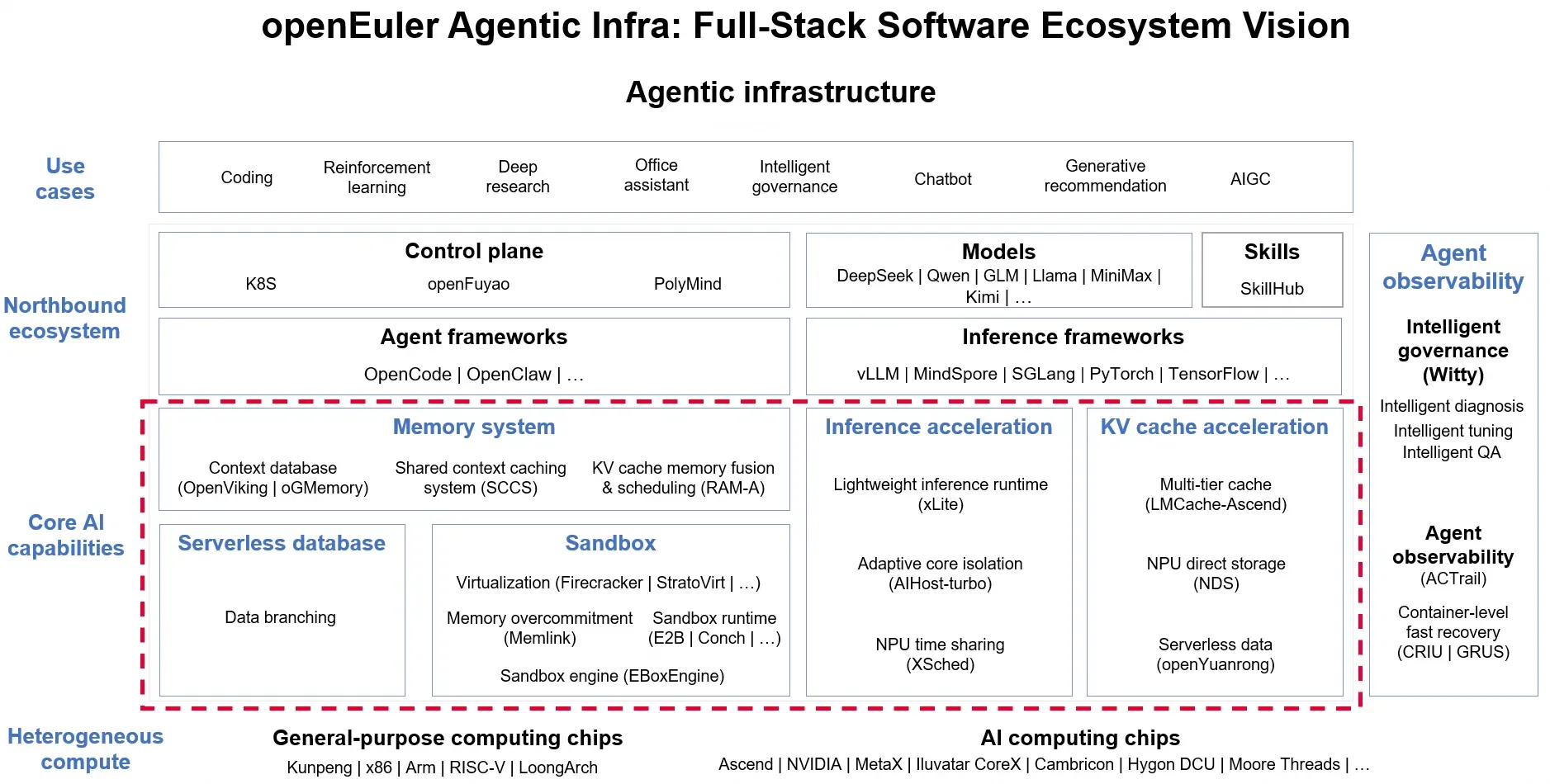
Five Pillars of Agentic Infrastructure
1. Sandbox: Secure, Scalable Agent Execution
Agents need isolated environments to execute generated code, invoke tools, and interact with external systems. These environments must start quickly, scale to high concurrency, and recover reliably when tasks are interrupted.
openEuler brings together lightweight virtualization, snapshot-based recovery, resource prewarming, and high-density scheduling to address these requirements. Technologies such as StratoVirt and the Conch runtime help create and manage sandbox environments, while orchestration capabilities support large-scale deployment.
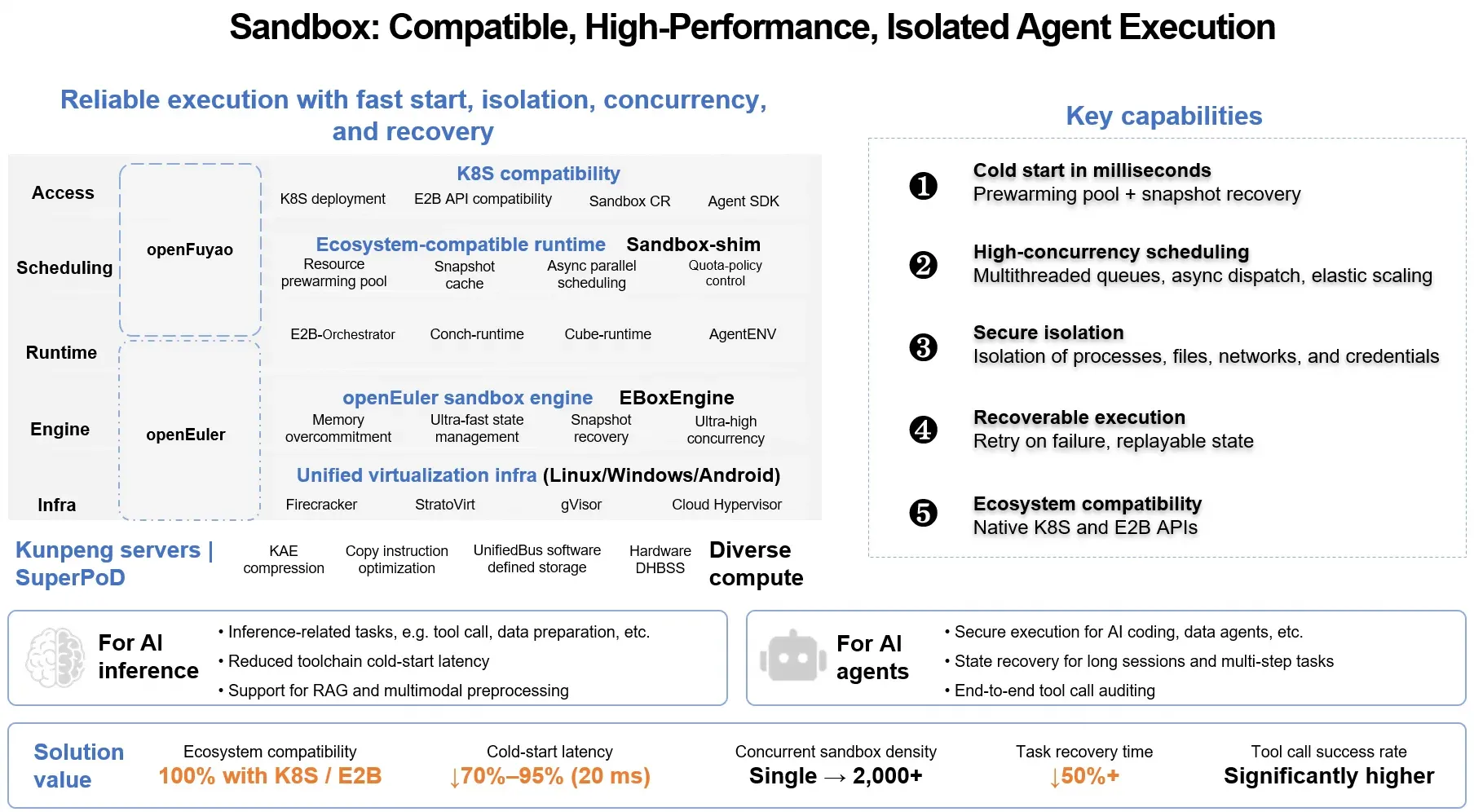
According to openEuler's performance tests, sandbox startup latency can be as low as 20 ms, with a density of more than 2,000 sandboxes. In a separate large-scale concurrency test, the platform launched 100,000 sandboxes within 10 seconds. These results demonstrate the potential for fast provisioning and high-density agent execution at scale.
2. KV Cache: Making Inference Context Reusable
In multi-turn agent workflows, repeated inference often involves substantial overlap in context. Recomputing or repeatedly transferring the same attention states wastes accelerator memory and increases time to first token (TTFT).
openEuler's KV cache approach combines multi-tier caching, global indexing, NUMA-aware placement, and high-speed cross-node data transfer. With technologies including LMCache and openYuanrong, KV cache can be reused across instances and accessed closer to compute resources.
Agent-aware scheduling takes this further: by mapping agent context to KV cache chunks, the system can predict reuse and proactively coordinate prefetching and eviction.
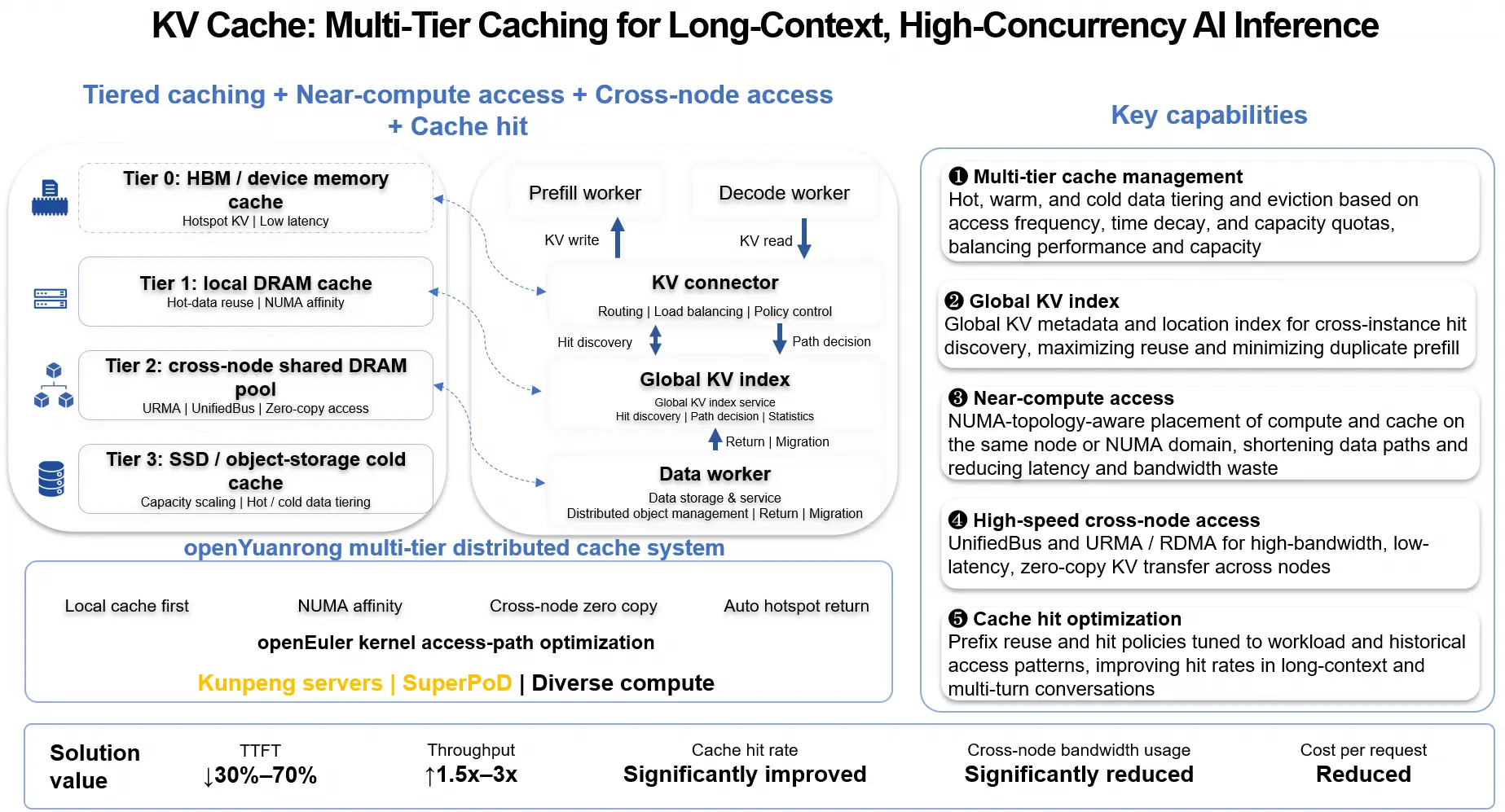
The performance gains are significant: inference throughput increases by 1.5x–3x, while time to first token (TTFT) drops by 30%–70% in targeted scenarios.
3. Memory Agent: Giving Agents Persistent Context
KV cache accelerates inference by reusing computed states. Agent memory addresses a different challenge: helping agents retain and retrieve useful knowledge across turns, tasks, and sessions.
openEuler's memory infrastructure combines memory extraction and orchestration frameworks with hybrid retrieval and storage capabilities. Solutions involving OpenViking, oGMemory, and openGauss support structured context management, vector and full-text retrieval, and knowledge sharing across agents.
This enables agents to retrieve relevant information when needed instead of repeatedly processing lengthy histories. It also supports shared knowledge accumulation in multi-agent workflows.
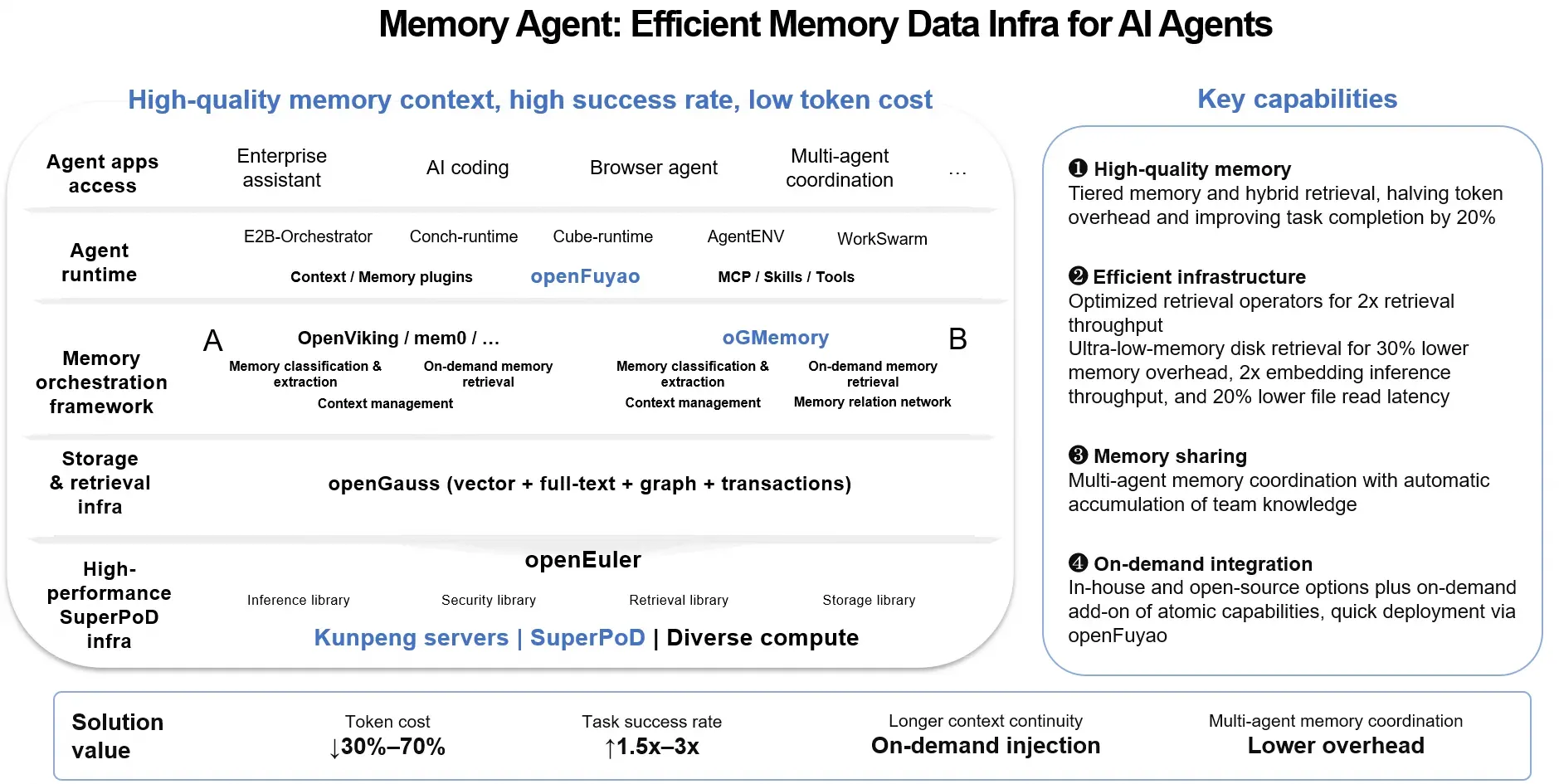
By retrieving only the context an agent needs, the system can cut token costs by 30%–70% and improve task success rates by 1.5×–3× in targeted scenarios.
4. Serverless Database: Enabling Elastic Data Services for AI Agents
Beyond the core Agent Kernel and Agent Service layers, data infrastructure plays an important supporting role in agentic workloads. Serverless database capabilities provide the elastic, branchable data environments needed by agents that create, modify, compare, and roll back data across dynamic workflows.
Built on openGauss, this approach combines elastic compute provisioning with copy-on-write storage and database branching. Multiple branches can share baseline data while maintaining independent changes. Point-in-time recovery, branch comparison, and merging further support flexible data workflows.
The result is a more dynamic data foundation for AI agents, where database environments can be provisioned, modified, and recovered as workflows evolve.
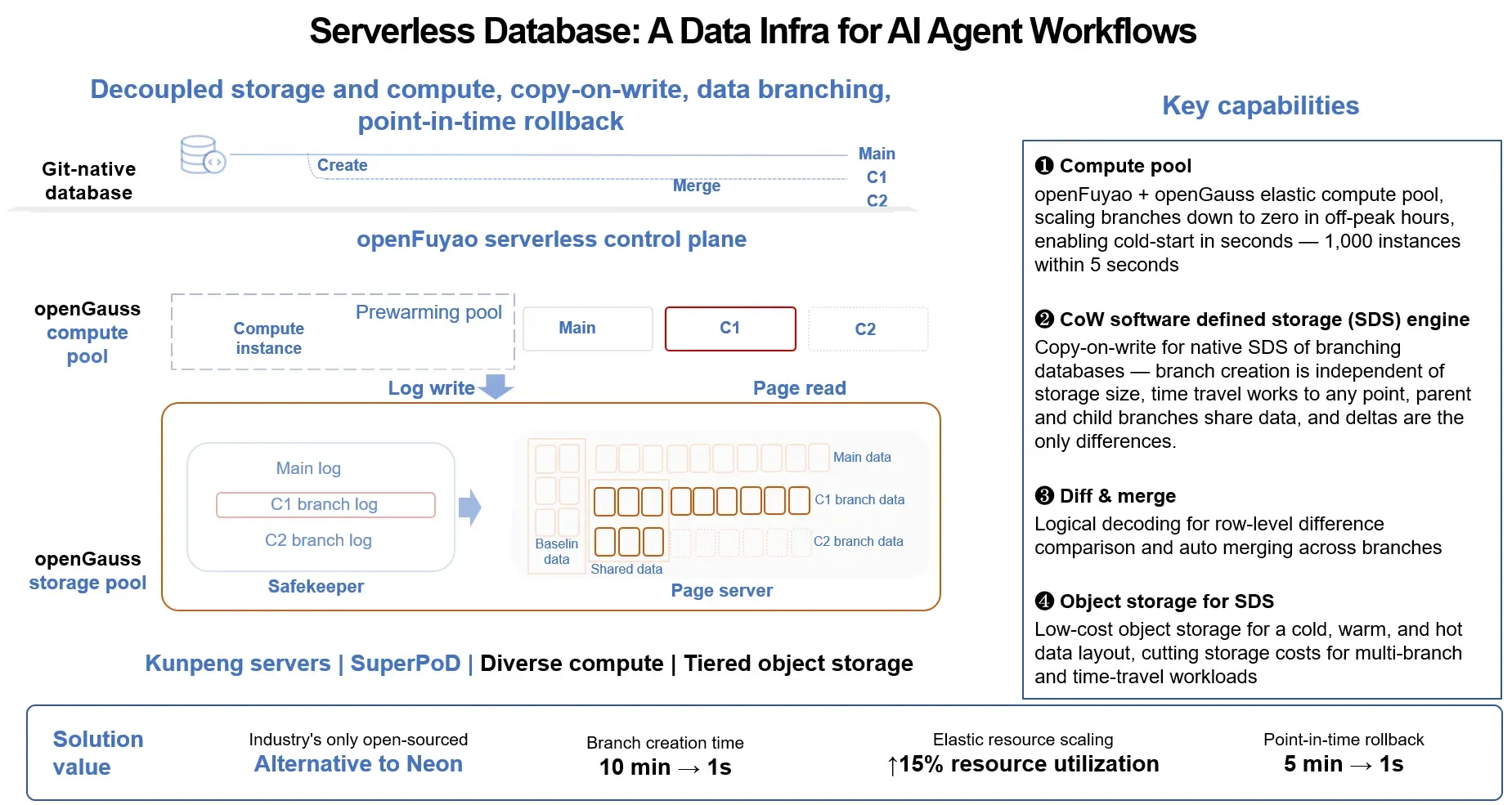
The solution is designed for rapid, elastic data provisioning, with millisecond-level instance startup and second-level database branch creation and rollback. These capabilities, enabled by compute elasticity and copy-on-write storage, allow agents to create and manage isolated data environments with minimal overhead.
5. An Open, Heterogeneous Ecosystem
Agentic infrastructure cannot depend on a single model, framework, or hardware platform. It must connect diverse components while making their resources manageable and accessible.
openEuler's ecosystem brings together agent frameworks, inference engines, orchestration platforms, memory systems, and heterogeneous processors and accelerators. Through collaboration with projects and technologies such as Kubernetes, openFuyao, vLLM, MindSpore, and openGauss, it aims to support different agent workloads across diverse computing environments.
The objective is not simply compatibility. It is to provide a consistent infrastructure foundation on which developers and ecosystem partners can build, deploy, and scale agent applications.
From an Operating System to an Agentic Infrastructure Foundation
The transition to Agentic AI is not simply another change in application development. It is reshaping the infrastructure requirements of enterprise computing.
As agents become more autonomous, infrastructure must support more than model inference. It must provide secure execution, efficient data movement, persistent memory, elastic data services, and reliable coordination across increasingly complex workloads.
openEuler's agentic infrastructure initiative addresses these requirements through five interconnected technology areas: an open infrastructure vision, high-performance sandbox execution, distributed KV cache acceleration, persistent agent memory, and serverless databases.
Each addresses a distinct bottleneck in agent deployment and execution. Together, they represent an approach to making agent capabilities more scalable, reusable, and manageable across heterogeneous computing environments.
- Sandbox: Secure and recoverable agent execution.
- KV Cache: Efficient reuse of inference context.
- Memory Agent: Persistent context and knowledge retrieval.
- Serverless Data Services: Elastic and branchable data infrastructure.
- Open Ecosystem: Integration across AI frameworks, orchestration platforms, and heterogeneous hardware.
Together, they point to a broader evolution in the role of the operating system. As AI agents become more autonomous and workloads increasingly dynamic, infrastructure must do more than allocate compute resources: it must help agents execute safely, operate efficiently, retain context, and scale reliably.
This is the infrastructure direction openEuler is exploring with agentic infra OS, building an open foundation for the next generation of intelligent enterprise computing.
Enjoyed this update? Support independent Linux news coverage
It's FOSS has been helping people use Linux for the past 14 years. Help us stay independent from big tech. Become a Plus member, enjoy ad-free reading and get 5 eBooks.
Skip the AI slop and SEO spam in your Google results
Tell Google you prefer It's FOSS, and it will show our Linux news and tutorials, created by experienced Linux users, more often when you search. It takes just a click.
Set as preferred sourceGet FOSS Weekly in your inbox