


Xen is a hypervisor that runs on various kinds of hardware, where a crash can have massive consequences. It is deployed in fields like automotive, industrial automation, robotics, and avionics. These are all safety-critical fields where certification matters.
So far, it has been on a good trajectory with increasing adoption and enhancements that keep it relevant for enterprise use. What it hasn't had is a structured, collaborative way to help the companies building on it actually get certified for that kind of work.
It has launched the Xen Safety Committee, a group tasked with building the safety documentation and test evidence that member companies can lean on instead of starting from scratch.
The committee's job covers software safety requirements, architecture specifications, MISRA-related engineering, DFMEA analysis, testing frameworks, tooling, code coverage, and process documentation.
Founding contributors AMD, EPAM, and Renesas are credited with doing most of the legwork for the above, forming the initiative's early foundation.
The point is to stop every company from solving the same problem on their own. Sharing this foundation should cut costs, avoid duplicated effort, and get products through certification faster for anyone building on Xen.
Nothing changes about how Xen itself gets built. Source code, licensing, and the existing open contribution and review process stay exactly as they are. The Safety Committee runs as a parallel governance layer, not a replacement for how maintainers already work.
Though joining the committee isn't all that open. Organizations will need to sign up for the right kind of membership. More on that below. 👇
A call for new members
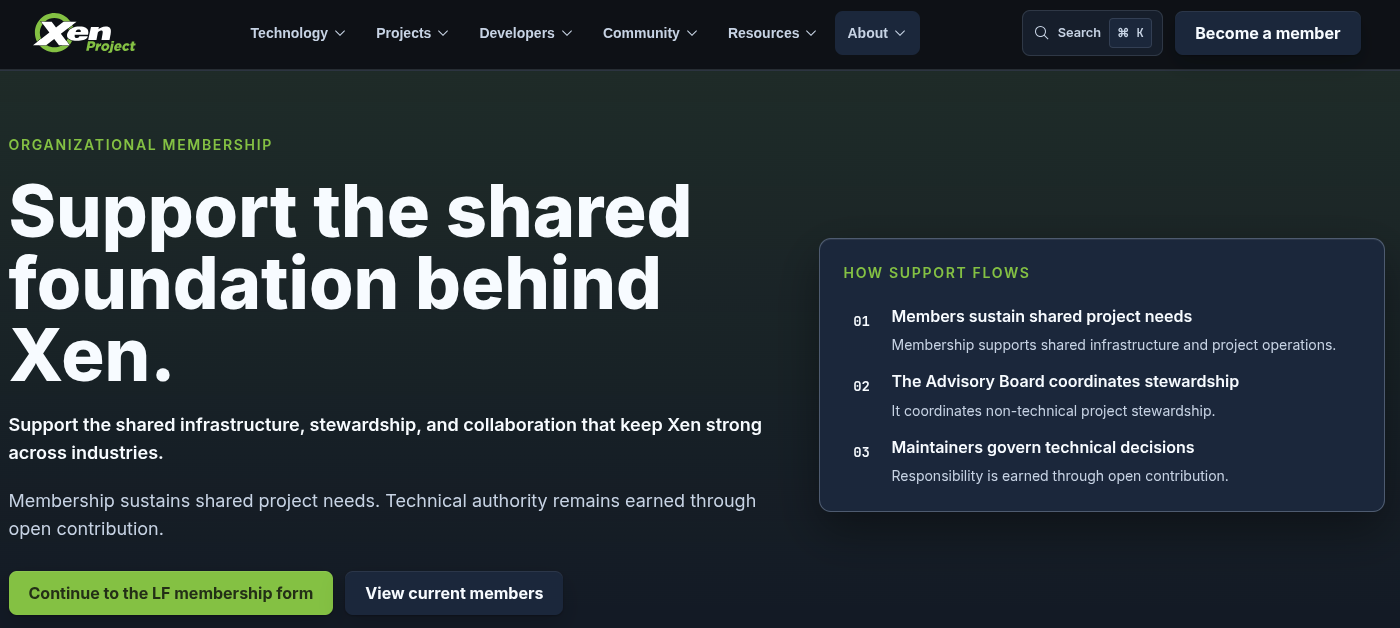
Membership at Xen Project works like most Linux Foundation projects. It funds shared infrastructure, test environments, events, and coordination, while day-to-day technical decisions stay with maintainers through open contribution.
Paying to join doesn't buy influence over the codebase. 🤓
AMD, ARM, AWS, Boeing, EPAM, Ford, Honda, Renesas, Vates, and XenServer are all listed as current members. These represent chipmakers, cloud providers, automotive, aerospace, and a few other sectors.
A new membership tier, "Premier Plus" sits above the existing tiers, granting voting representatives on both the Xen Advisory Board and the Safety Committee, a say in setting priorities and roadmap, and access to the committee-managed safety artifacts.
This way, instead of producing every requirement and test in house, members can hand the committee's existing artifacts to their own safety assessors for audits and assessments.
Speaking on the topic, Kate Stewart, Vice President, Dependable Embedded Systems, The Linux Foundation, stated that:
Systems with safety considerations need a trusted hypervisor to provide the foundation for other open source components, such as Zephyr and Linux, to support mixed criticality embedded applications.
The Zephyr and Xen projects have been exchanging best practices over the last few years as a pathway to achieve safety certification of open source components. We welcome the Xen Safety Initiative to accelerate the journey of Xen achieving formal certification.
Suggested Read 📖: Proxmox Virtual Environment Officially Runs on ARM64
 Sourav Rudra
Enjoyed this update? Support independent Linux news coverage
It's FOSS has been helping people use Linux for the past 14 years. Help us stay independent from big tech. Become a Plus member, enjoy ad-free reading and get 5 eBooks.
Skip the AI slop and SEO spam in your Google results
Tell Google you prefer It's FOSS, and it will show our Linux news and tutorials, created by experienced Linux users, more often when you search. It takes just a click.
Set as preferred sourceGet FOSS Weekly in your inbox