


Proton has launched AI Paper Trail, a free tool that shows people what their AI chatbot conversations reveal about them. It runs on Lumo (partner link), the company's privacy-focused AI assistant, and works by digging through exported ChatGPT or Claude conversation history.
Once you upload your content, the tool starts building a personal report around four categories. There's a "Privacy Type," a personality label based on how someone approaches their own data. Then comes an "AI Exposure Score," a number built from how many personal data points got pulled out of the conversations and how revealing they are.
The report also breaks down what the AI actually knows about you, covering identity, habits, relationships, and interests. On top of that, it puts a monetary figure on what this information could be worth to an AI provider.
And none of the uploaded data sticks around on Proton's server; the company says that it gets deleted right after analysis, and the resulting report stays visible only to the person who generated it.
The reasoning behind AI Paper Trail comes down to how casually people treat individual AI prompts. A single question about travel plans or a work email draft might seem harmless on its own.
But stack up months or years of conversations covering someone's job, relationships, health concerns, and finances, and a surprisingly complete picture starts to form.
Eamonn Maguire, Director of Engineering at Proton, notes that:
People understand that AI collects data, but most don't realize how revealing their conversation history becomes over time. AI Paper Trail makes that invisible profile visible.
We want people to understand what they're sharing with AI systems so they can make informed decisions about the tools they use.
What they have done here is hit two targets with one shot, offering people a privacy-focused tool that pushes them toward more conscious decisions when interacting with AI chatbots, while steering them straight into Lumo in the process.
This is a superb way to market a chatbot that focuses on privacy instead of mining every inch of your soul, erm, personal data.

It works well
I wanted to see for myself how the tool worked, so I first ChatGPT some information about how I approach certain subjects, saved it into memory, and then got back into Proton's AI Paper Trail to see what it could make of it.
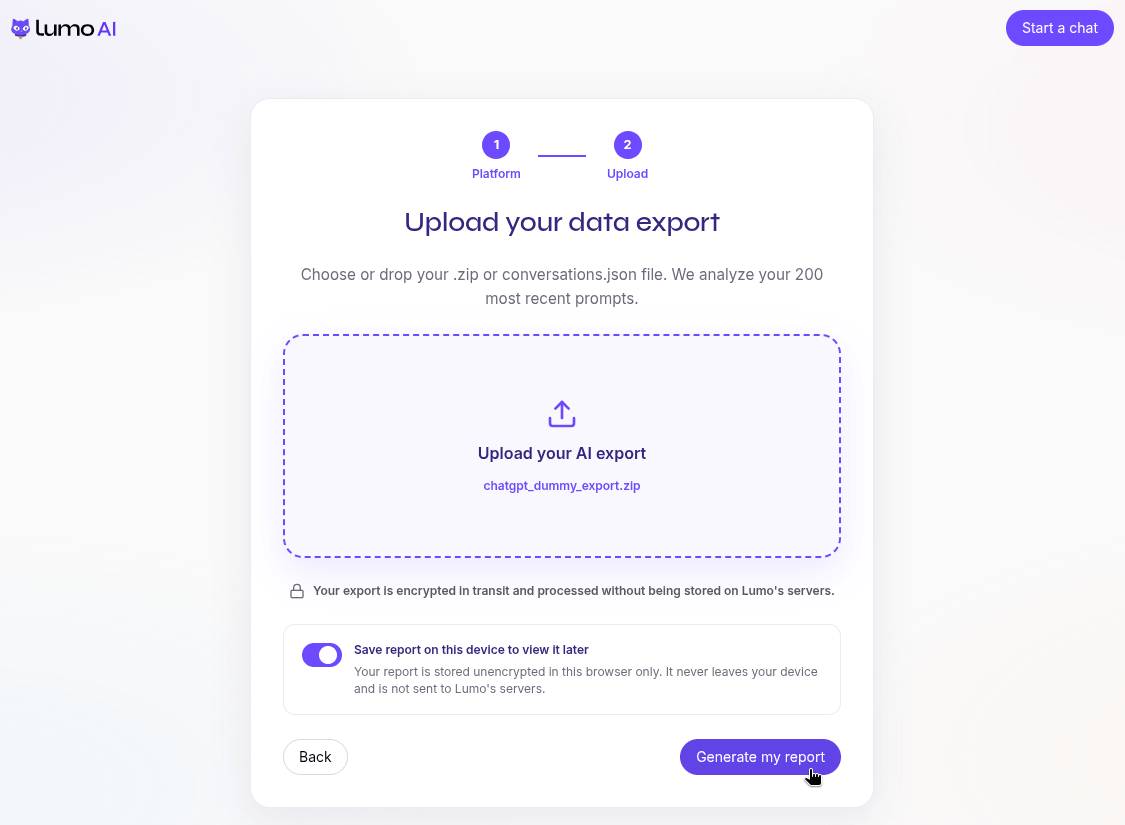
The tool first told me to export my data from ChatGPT via the "Data controls" section in the Settings menu. I had to re-verify my ChatGPT session by giving it a one-time password and got the export started, but the files never showed up on time for me to use.
Instead, I asked it to generate me a dummy one taking in data from memory. 😆
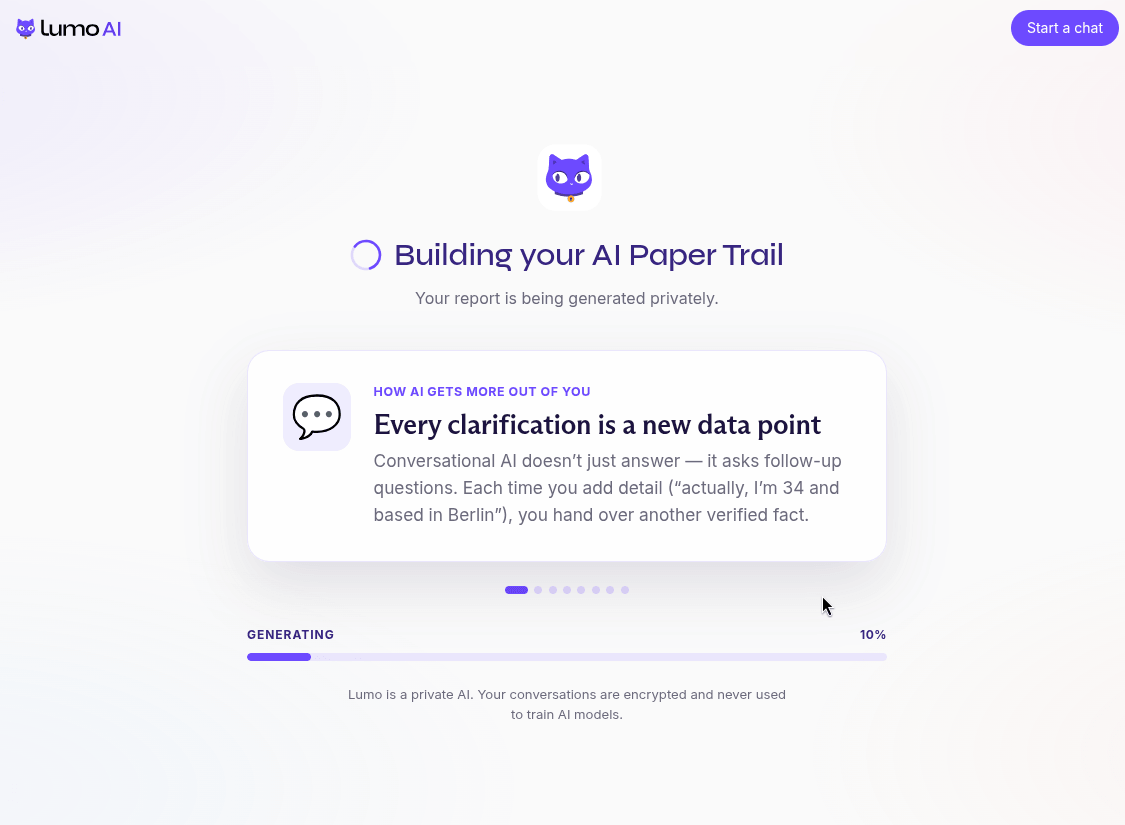
When that was done, I uploaded the dummy export, and Lumo got to work behind the scenes all while promising not to store any of it on its servers.
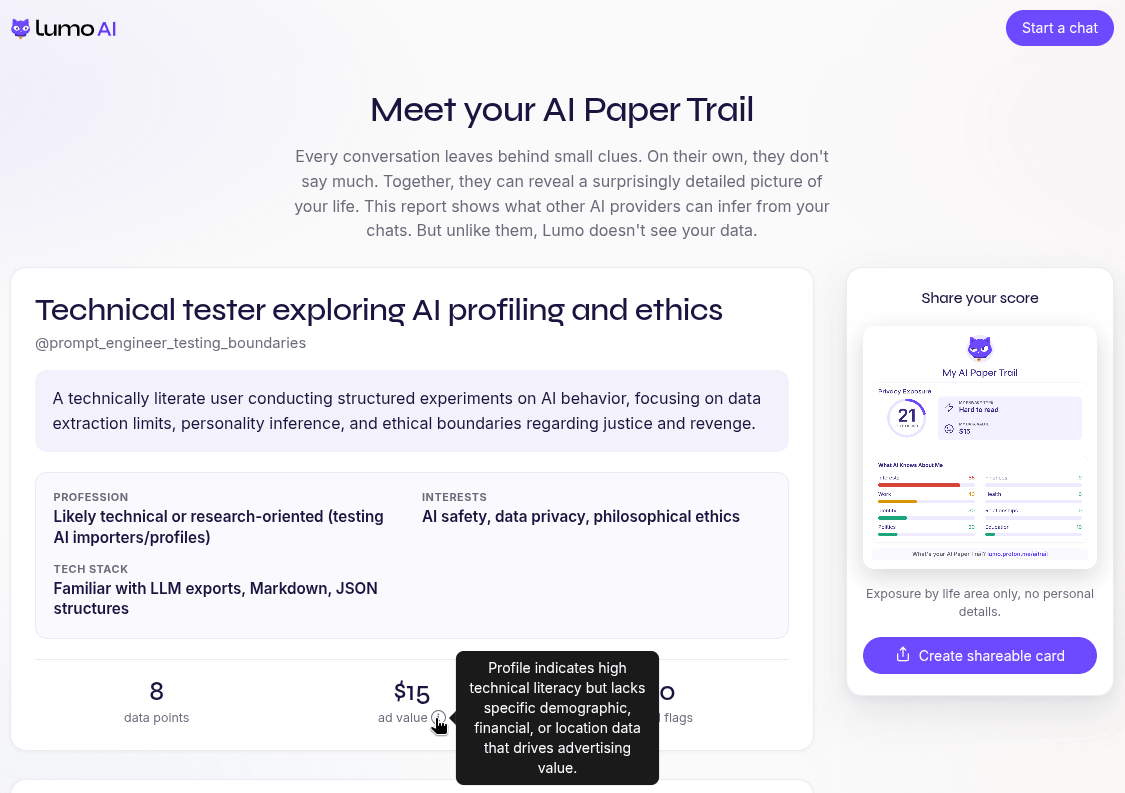
A minute or so later, my report was ready. It gave me a personality-style rundown, labeling me a "Technical tester exploring AI profiling and ethics," complete with a fake handle and a summary pegging me as someone running structured experiments on AI behavior, focused on data extraction limits and ethics.
My AI Exposure Score came out to 21 out of 100, along with a "Hard to read" privacy type. Interests ended up being my biggest giveaway on the breakdown, while everything else landed at medium to minimal.
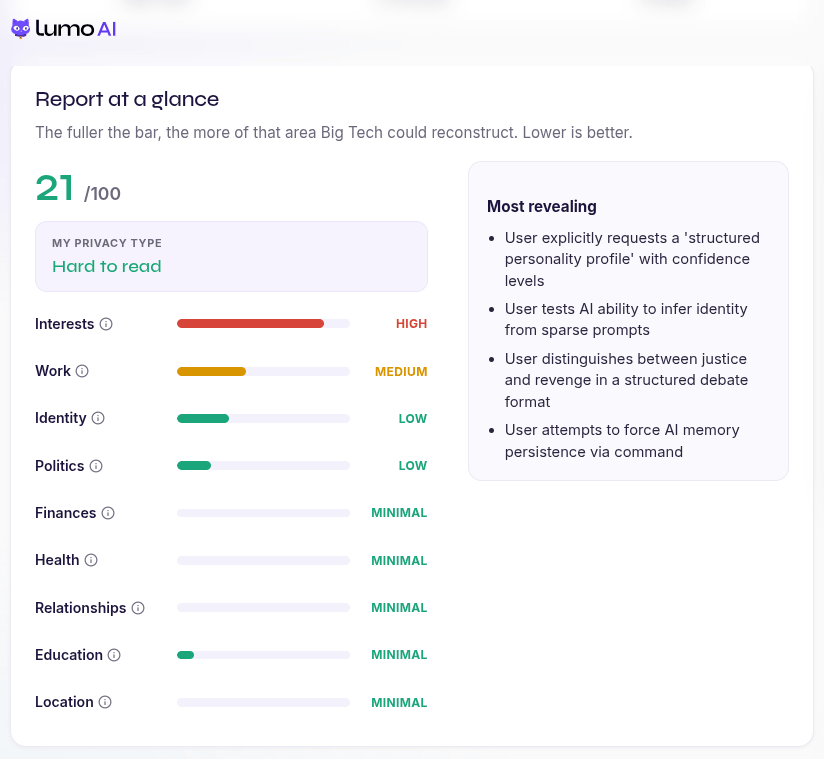
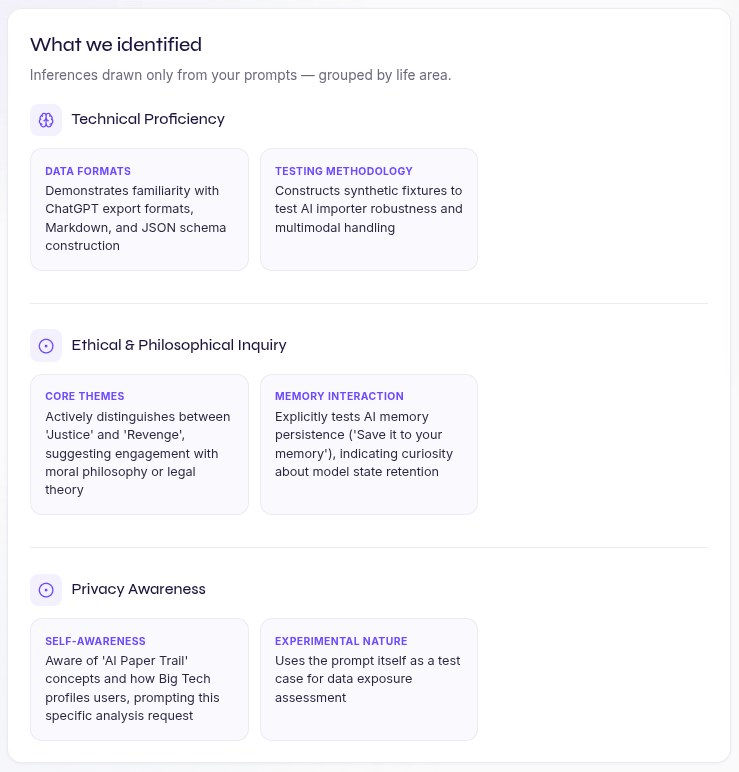
The part that actually got me was the "Most revealing" note (first picture above, right-hand side). It noticed I'd asked for a structured personality profile, tried to get it to infer my identity from barely anything, and even caught me trying to force it to remember something via a direct command.
Since I'd gotten ChatGPT to build that dummy file straight from its own memory of me rather than pulling random filler, the report had real clues to chew on, and it still managed to call out the testing motif buried in there.
Scrolling further down, there's a "What we identified" section that splits everything into categories like technical proficiency, ethical and philosophical inquiry, and privacy awareness, each with its own reasoning attached.
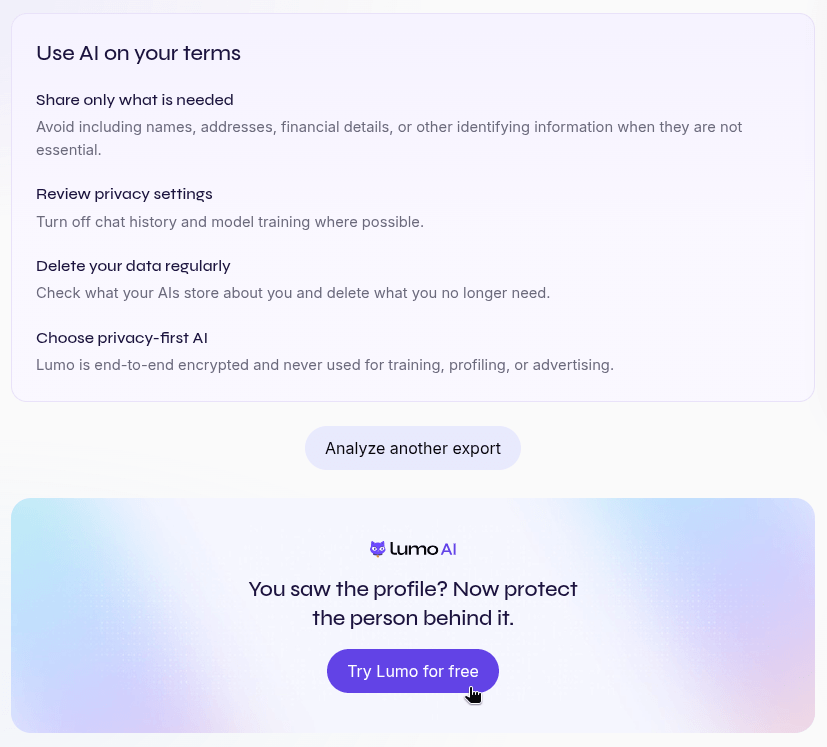
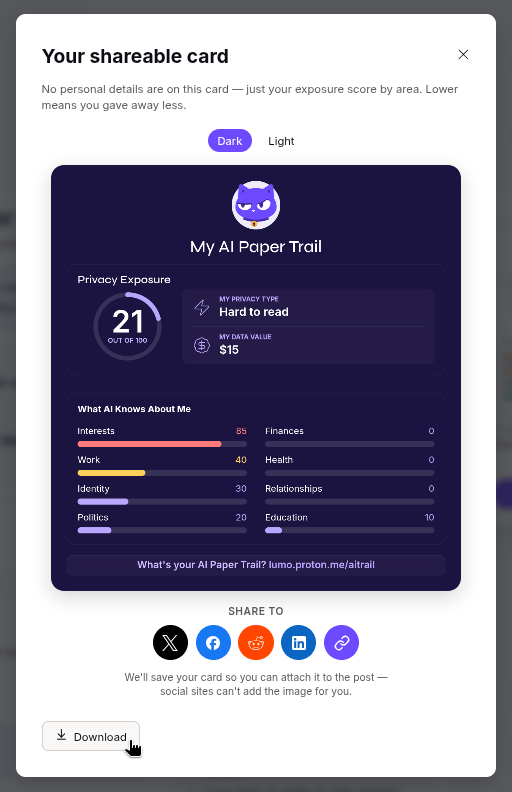
At the end, it dropped a few privacy tips and nudged me toward trying Lumo (partner link, hehe). There's also a shareable card option if you want to showcase your exposure score for some validation or gloating.
Enjoyed this update? Support independent Linux news coverage
It's FOSS has been helping people use Linux for the past 14 years. Help us stay independent from big tech. Become a Plus member, enjoy ad-free reading and get 5 eBooks.
Skip the AI slop and SEO spam in your Google results
Tell Google you prefer It's FOSS, and it will show our Linux news and tutorials, created by experienced Linux users, more often when you search. It takes just a click.
Set as preferred sourceGet FOSS Weekly in your inbox