


PhoneBuff is a company that built its name by offering lab-tested, standardized reviews for smartphones run by robotic hands. Their YouTube channel showcases a range of assessments that cover speed tests, drop tests, and battery tests.
When viewers started poking them about trying Linux after a recent performance comparison they did between a Dell XPS 13 and MacBook Neo, they responded.
Taking two identical Dell XPS 13s with an Intel Core 5 320 and 8GB of RAM, one on Windows 11 and one on Fedora, the PhoneBuff crew ran the same real-world apps and workflows on each, timed by their robot mouse and keyboard (aka the clanker in question).
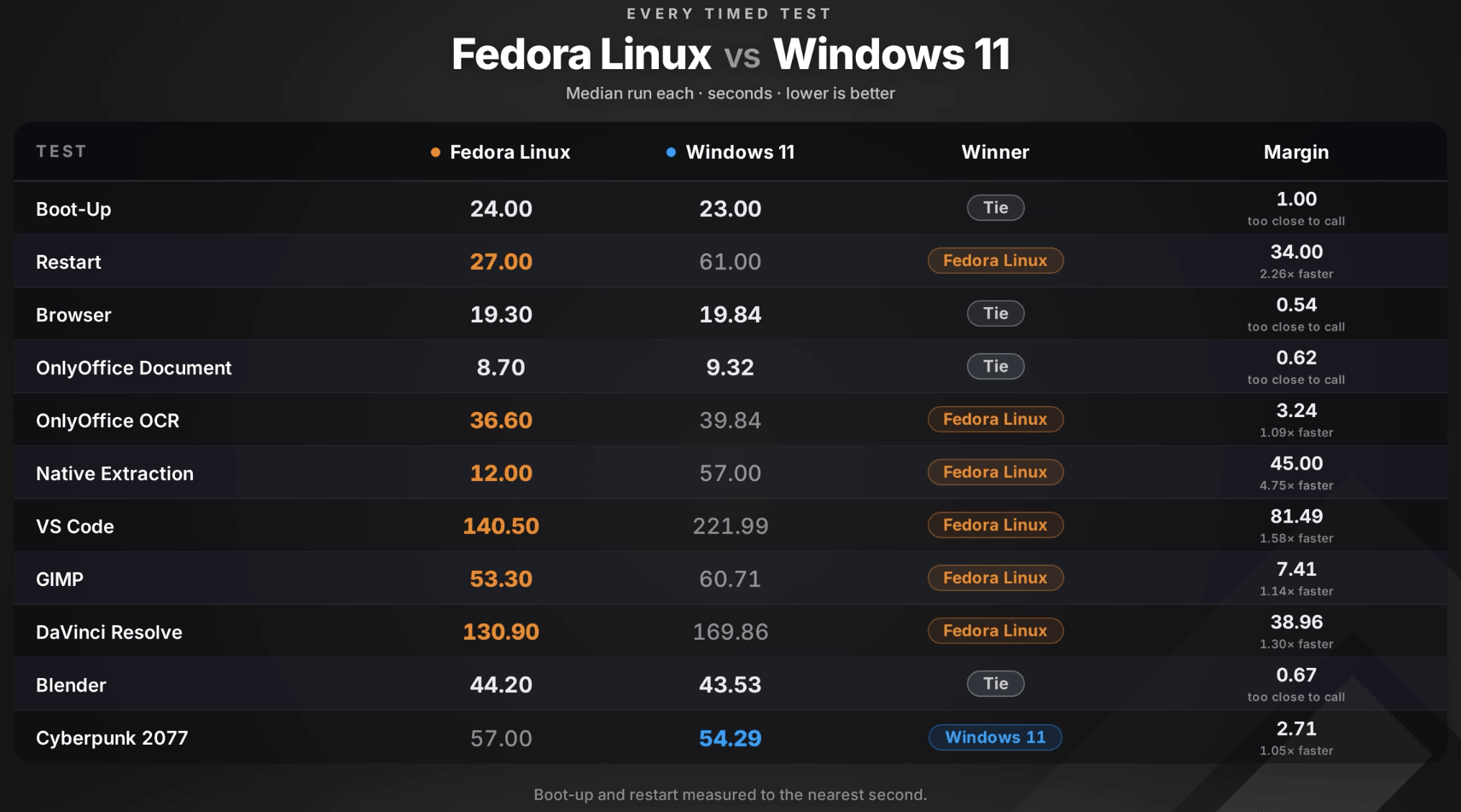
By the time testing concluded, Fedora won six of eleven timed tests while four tied, and Windows 11 took home a single win.
Fedora vs. Windows 11 on same hardware
Same settings too! The screens sat at 200 nits, both laptops stood an equal distance from the WiFi point, and the room stayed temperature controlled. Each test was run three to five times, with the median value noted.
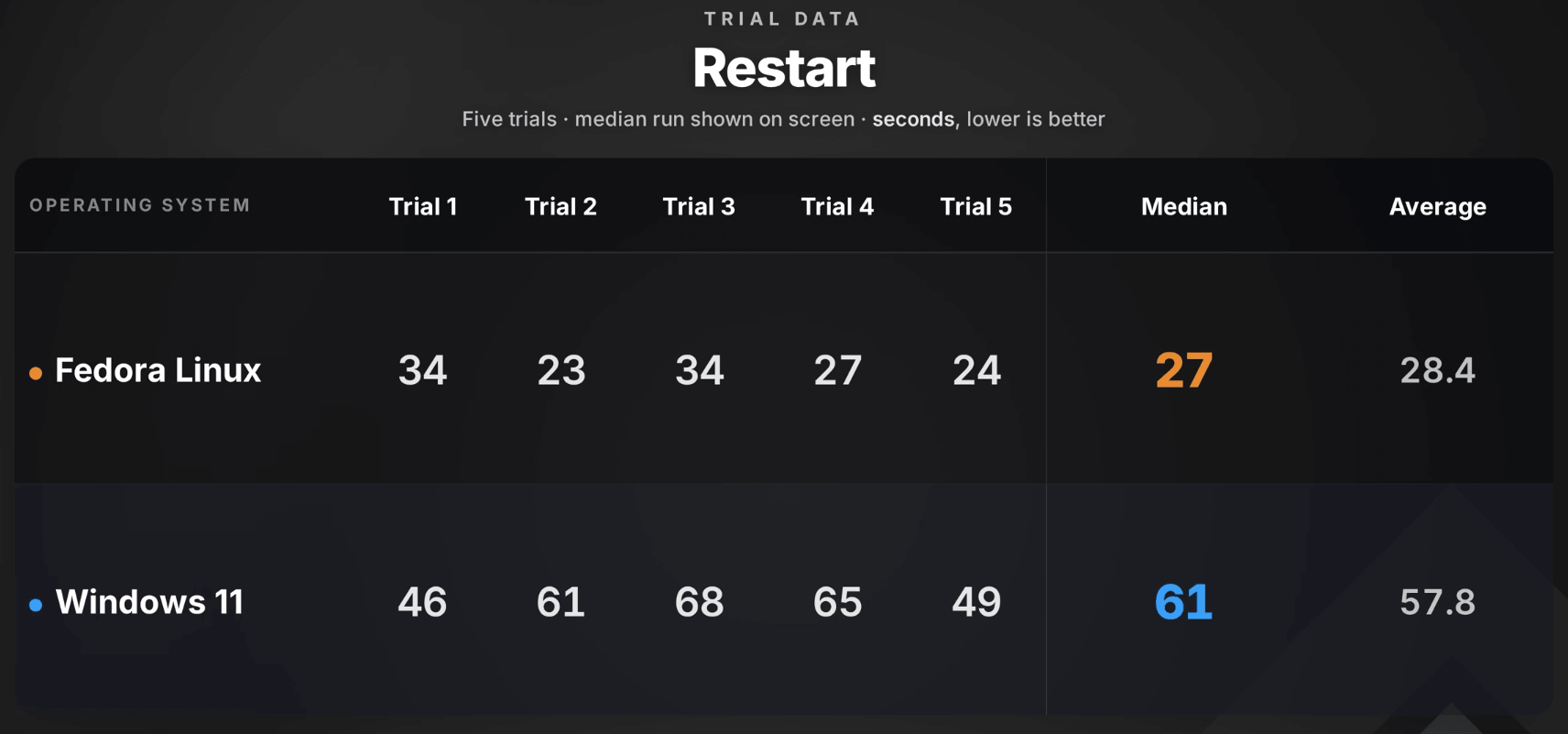
Boot from a full shutdown tied at 23 seconds for Windows and 24 seconds for Fedora, too close to call. Restarting did not. Fedora came back in 27 seconds, median; Windows took 61 seconds. Windows' five runs swung 46 to 68 seconds, Fedora's 23 to 34 seconds.
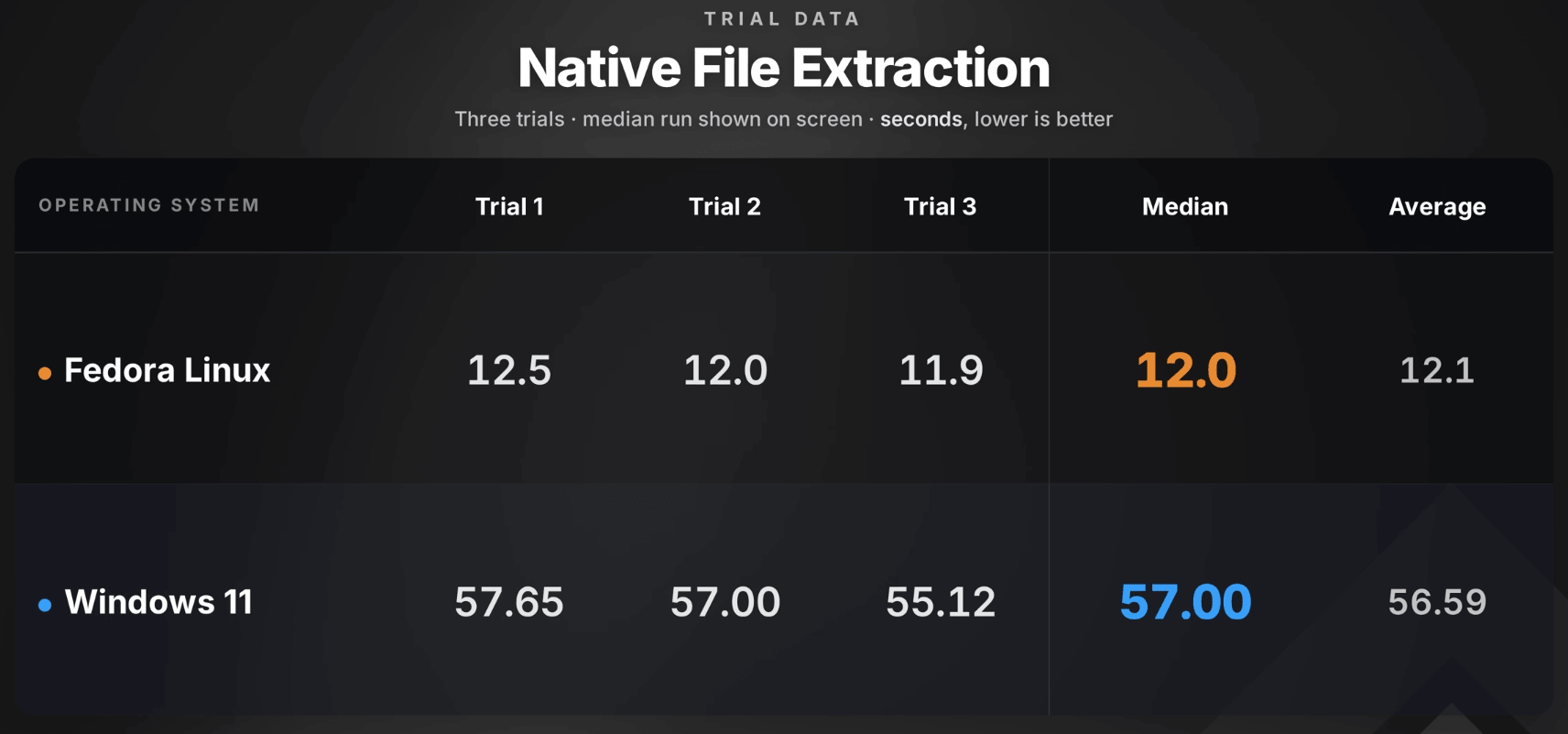
The widest gap was files. Unzipping the same 6GB archive took Fedora's built-in tool 12 seconds. On Windows, using Windows Explorer, it was 57 seconds, and installing 7-Zip only got it down to 17.4 seconds.
Next comes the result that ought to sting Microsoft. Running VS Code, the robot loaded an open source whiteboard project, scanned it for errors, compiled it, and ran close to 1,900 tests. Fedora was done in 2:20.5. Windows 11 needed 3:41.99.
Source: PhoneBuff
The creative apps went the same way. DaVinci Resolve imported two clips, graded one, stabilized the other, and exported in 2:10.9 (Fedora) against 2:49.9 (Windows). A GIMP session on a 4K image, using tools like smudge, heal, and object removal, finished 53.3 seconds against 60.7 seconds.
The everyday apps were mostly a tie. Chrome on a locally hosted page with video, 3D models, maps, and chart math finished in 19.3 seconds on Fedora against 19.8 on Windows.
The same 500-page document opened in ONLYOFFICE in 8.7 seconds against 9.3, while the OCR pass also went to Fedora, 36.6 seconds against 39.8.
Even the Blender render of the same 1080p scene ended even, 44.2 seconds against 43.5.
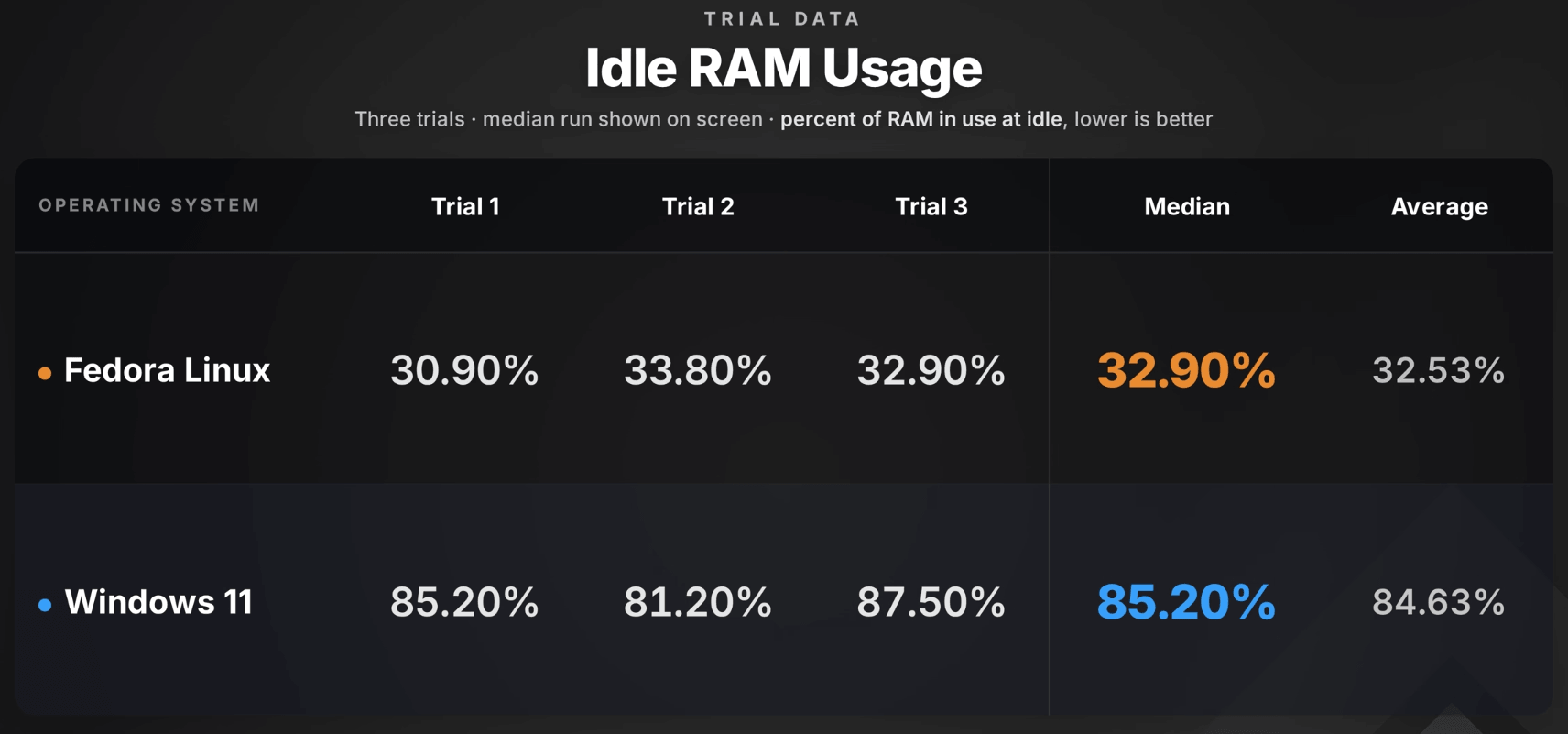
Idle memory usage was another big gap. Left idle for a minute, Fedora used 32.9% of the 8GB while Windows sat at 85.2%. The video showed 2.27GB being used on Fedora against Windows' 6.47GB.
The lone Windows win was launching Cyberpunk 2077, 54.3 seconds against Fedora's 57.0-second launch. Though remember, that is a launch time number, not a frame rate, and PhoneBuff didn't run any gaming benchmarks.
What do the numbers mean?
Do not read too much into it yet. There are no AI workloads here, and as I just said, no gaming benchmarks either.
The presenter for PhoneBuff says at the beginning of the video that Fedora is one of the many Linux distros out there and that "this won't necessarily represent every possible Linux experience."
A different distro running a different desktop environment will definitely move some of the gaps we see here.
The RAM gap comes with an asterisk too. Windows sat at 85.2% with a few Dell utilities, Defender (MsMpEng), and Edge WebView2 running by default, so Windows is not the only thing behind that 6.47GB number. Fedora simply started off with less baggage.
To summarize, the heavy tasks went to Fedora, sometimes by minutes, the everyday ones tied, and idle RAM sat at around a third on Linux against 85% on Windows.
That is all eleven tests can claim, so take them as data points, not a verdict.
Enjoyed this update? Support independent Linux news coverage
It's FOSS has been helping people use Linux for the past 14 years. Help us stay independent from big tech. Become a Plus member, enjoy ad-free reading and get 5 eBooks.
Skip the AI slop and SEO spam in your Google results
Tell Google you prefer It's FOSS, and it will show our Linux news and tutorials, created by experienced Linux users, more often when you search. It takes just a click.
Set as preferred sourceGet FOSS Weekly in your inbox