


When the U.S. government imposed sanctions on the International Criminal Court (ICC) in early 2025, the consequences were far-reaching yet quickly enforced.
The restrictions cut off the ICC chief prosecutor's access to Microsoft services, including email, followed by a freezing of his personal and institutional bank accounts in affected jurisdictions.
While this was happening, the Dutch government was watching, coming to the bitter realization that access to essential services depended on decisions made in the U.S.
Hence, their response to this is DAWO, short for Digitaal Autonome Werkomgeving Overheid, or Digital Autonomous Work Environment for Government in English.
It is a framework that looks to tackle the government's digital stack, covering the OS, an office suite, collaboration apps, cloud services, IT management tools, and AI, with all of it being built around a NixOS foundation.
How it came to be
The DAWO initiative became an official government mandate in July, when the Interdepartmental Commission for Government Business Operations (ICBR) issued a directive for a standardized, sovereign digital work environment.
The three major IT service providers of the Dutch central government, SSC-ICT, DICTU, and DUO-ICT, are tasked with executing this major undertaking.
Development is handed by a team that is associated with the Ministry of the Interior and Kingdom Relations (BZK), with some notable people like Victor Gevers, Rutger Putter, and Bram Buijs being named.
Why go with NixOS?
Nix, the package manager NixOS is built around, handles configuration through its own functional programming language. Each package installs into an isolated directory with immutable, signed contents.
That makes a working setup reproducible across machines. For a rollout spanning dozens of agencies, that reproducibility adds up, resulting in substantially less repeated configuration work that would cost time and money.
Rutger estimates around 80 to 90 percent of a configuration carries over between deployments. NixOS also runs on hardware Windows 11 cannot, which is why the current pilots (more details below) are being run on decommissioned laptops that would otherwise be out of service.
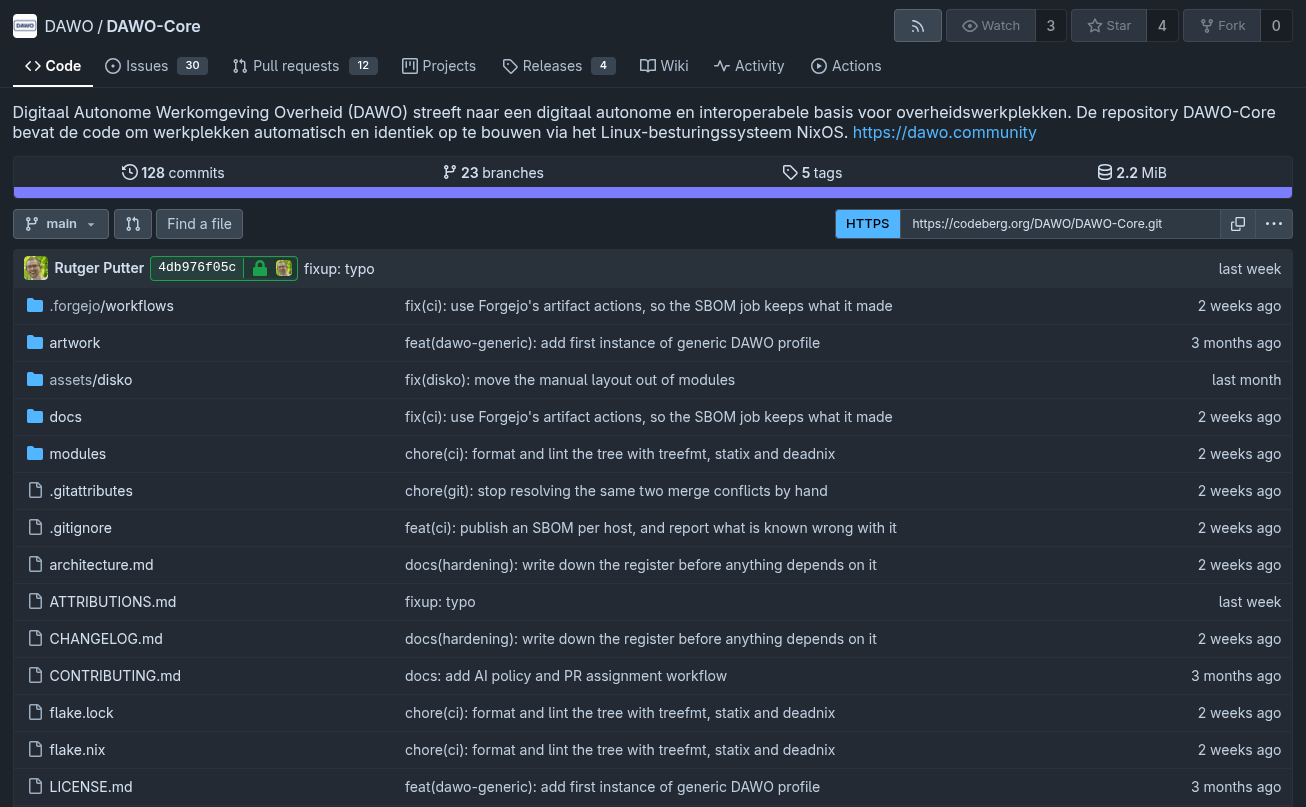
For handling the code, this initiative is following a similar approach to the country's earlier Forgejo migration, where they moved their code hosting away from GitHub and GitLab.
All of DAWO's code is hosted on a Forgejo instance, with a separate Codeberg instance acting as the entry point for contributors. And, to answer the question asked earlier, NixOS was chosen because it is a Dutch project, with no company owning or controlling its development.
Before settling on it, the DAWO folks were considering openSUSE and Fedora. Both were disqualified due to their commercial ties, openSUSE to SUSE and Fedora to Red Hat, which in turn is owned by the US-based IBM.
Suggested Read 📖: Garuda Linux has begun pushing towards NixOS.
Things are looking up
Eight municipalities are running trial programs via the Association of Dutch Municipalities (VNG).
The ICC incident is what makes this different from other government-level open source pushes, as Dutch officials were given a first-hand reminder of what vendor dependency could cost them.
Of course they are not alone in doing so. Germany's Schleswig-Holstein went through something similar after leaving Microsoft. Part of what it used to spend on licenses now goes towards supporting open source projects.
Denmark and France have made similar moves of their own, where one is ditching MS services for their road traffic authority and the other is pushing a Linux switch across ministries, with 80,000 health insurance employees already moving to domestic tools.
As for where DAWO goes from here, they intend to release the first stable version sometime next year, taking in feedback from all the concerned parties (e.g., the municipalities).
Via: Tweakers
Enjoyed this update? Support independent Linux news coverage
It's FOSS has been helping people use Linux for the past 14 years. Help us stay independent from big tech. Become a Plus member, enjoy ad-free reading and get 5 eBooks.