


If a tool makes things faster and efficient, that is a life-saver for many developers.
While there are different services and platforms that try to make the coding experience quicker, you still have several other options to consider.
For instance, a code snippet manager. With a snippet manager, you aim to save a section of code that you want to quickly access. It is more like assigning shortcuts to add the required code in your program.
This is not a new concept, but the tools available for the job may not be entirely open-source.
Fortunately, I stumbled upon a decent project that provides you with a free and open-source snippet manager, i.e., massCode.
massCode: Cross-Platform Open-Source Snippet Manager
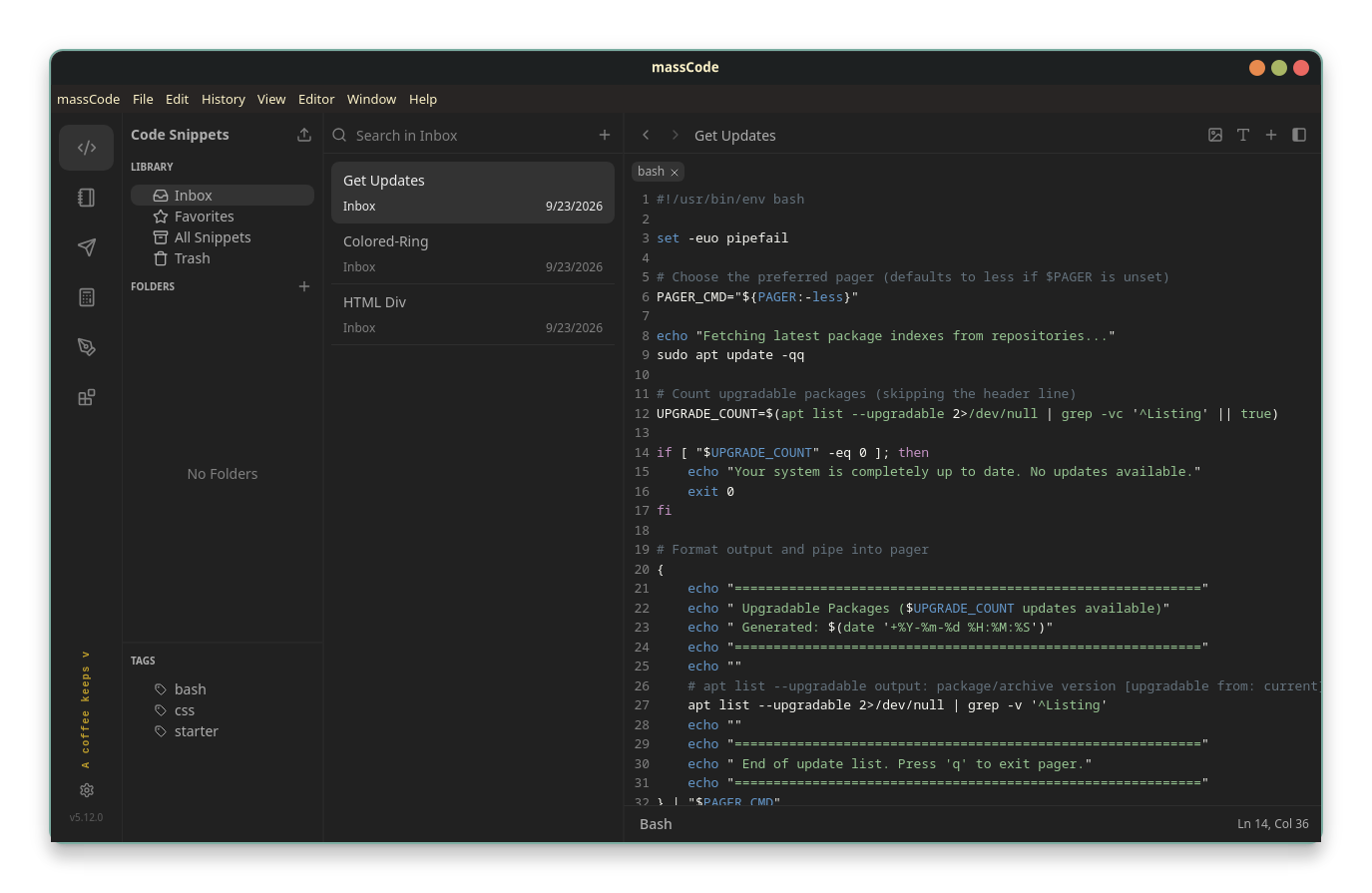
massCode is an open-source productivity app that has grown from a humble snippet manager into an all-in-one developer workspace.
While it still excels at organizing and highlighting code fragments across hundreds of languages, it now packs tools for your entire workflow. You get dedicated spaces for markdown documentation, an integrated API and HTTP client, interactive math scratchpads, and even built-in Excalidraw diagrams, all stored locally on your machine as plain Markdown files.
massCode is available for Linux, Windows, and macOS. Let's take a look at some of its key features.
Snippet Manager
For reusable code, massCode gives you a focused workspace where snippets can be organized with multi-level folders, tags, and fragments. This makes it easier to keep frequently used pieces of code neatly arranged across projects and languages.
It supports 100+ syntax grammars out of the box, with support for additional grammars. There is also built-in Prettier integration for formatting your code while you work.
Some of the cool features I found out was the JSON previewer, which can show you a graphical chart along with pretty print form.
Viewing JSON in Pretty Print and Graph form.
Another interesting thing is the ability to save the snippet, along with the syntax highlighting to customizable images.
Saving Snippet as Customizable images using the massCode settings.
A Note Manager
Beyond code snippets, massCode also gives you a place to write longer Markdown content, whether it is project documentation, drafts, research notes, or personal knowledge bases. You can work with your notes using the editor, live preview, or a dedicated preview mode.
massCode as a Note Manager
Notes can also include useful features such as editable Markdown tables, internal links, callouts, images, and Mermaid diagrams. You can link notes with snippets and HTTP requests too, making it easier to keep related information together.
HTTP Client
There is an HTTP client for building and testing API requests alongside your snippets and project notes. You can work with HTTP and GraphQL requests, organize them into collections, and keep related requests together for easier access.
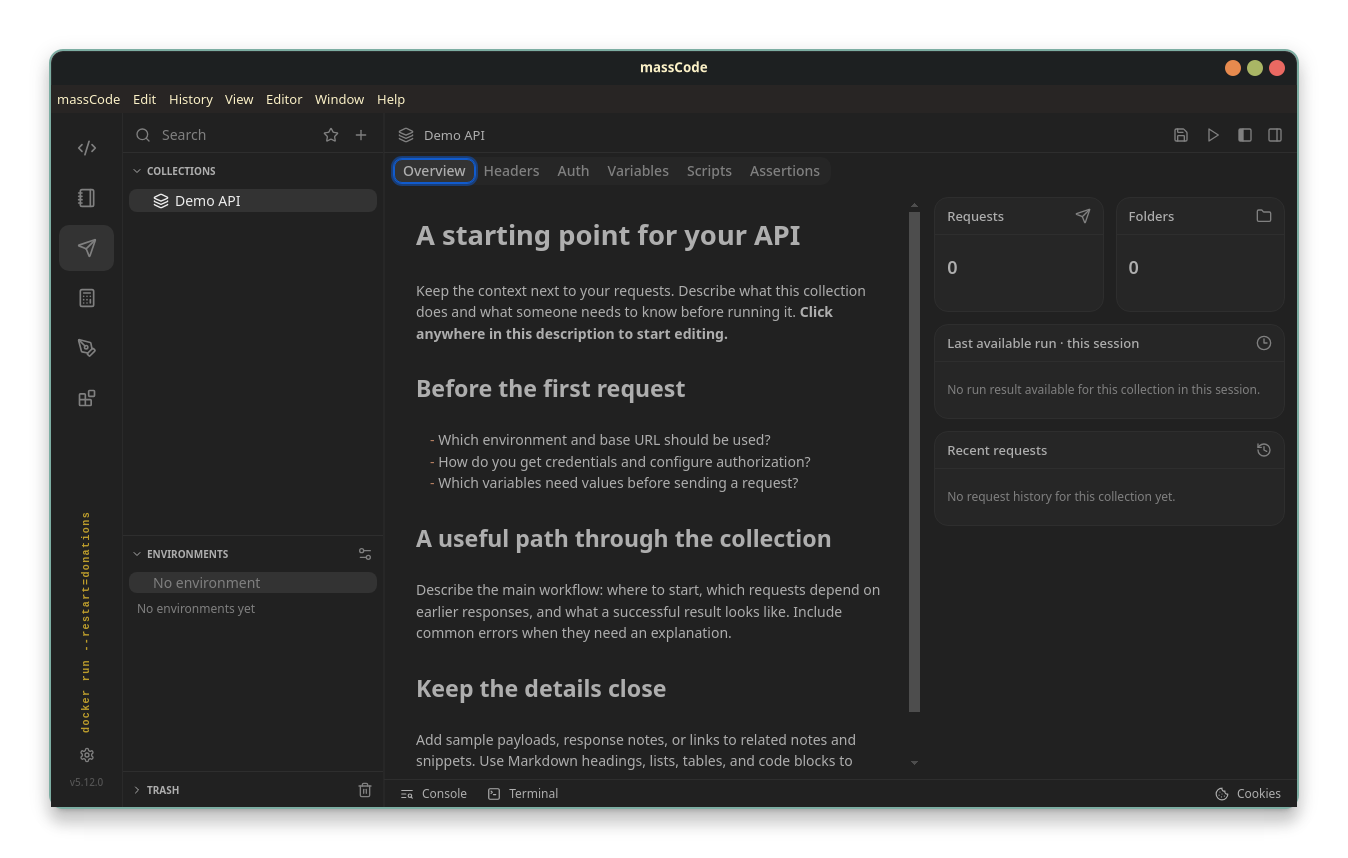
It also supports different environments and lets you save common authentication, headers, and variables for your requests. Responses and request history can be inspected within the app, while collections can be imported from tools such as OpenAPI, Postman, and Bruno.
MCP Integration
massCode can connect Codex, Claude Code, Cursor, and VS Code Copilot to your vault through its built-in MCP server. Your coding agent can find and read snippets, notes, and saved HTTP requests stored in massCode.
It can save code, Markdown notes, and HTTP requests directly to the Inbox, as well as send saved HTTP requests using the active massCode environment. This makes it easier to work with your existing massCode content from your coding agent.
A user-friendly command palette
The command palette gives you quick access to different actions across the app. You can use it to search for commands and run them without having to navigate through different menus.
To access the command palette, use the shortcut Ctrl + P.
massCode Command Palette
Developer Tools
massCode has a collection of built-in developer tools for handling small tasks that you might otherwise open a browser tab for. You can use them to compare JSON data, convert text, generate hashes and passwords, and work with different encoding formats.
Developer Tools in massCode
It can handle things such as converting JSON into other common data formats, generating UUIDs and Lorem Ipsum text, and converting colors between different formats. There are enough small utilities here to take care of many of those quick development tasks without reaching for a separate online tool.
Browser Clipper
The browser clipper lets you save web content from Chrome, Firefox, or Safari directly to your local massCode app. Selected code can be saved as snippets, while text or readable page content can become notes. You can even save a page or link as an HTTP GET request.
Web Clipper in massCode
It connects to massCode through the local Integration API using an API token, making it easy to send useful content from the browser straight into your workspace.
Honorable Mentions
- Markdown Vault: Store snippets, notes, and HTTP requests as plain Markdown files with frontmatter. The vault is Git-friendly, supports cloud syncing, and picks up external changes in real time.
- Imports: Import snippets from VS Code, Raycast, SnippetsLab, and GitHub Gists, Markdown notes from Obsidian, and API collections from OpenAPI, Postman, and Bruno.
- Custom Themes: Customize the app and editor with JSON themes, including light and dark themes with live reloading.
Install massCode on Linux
massCode is available as an AppImage for Linux. Go to the official downloads page of massCode and download it for Linux:
Once downloaded the AppImage, you can use any of the AppImage management tool to integrate it to your system.
If you don't want that, give the AppImage file execution permission:
chmod +x path/to/downloaded/massCode.AppImage
Now, double click on the file to launch the application.
Read more about managing AppImages in Linux on our dedicated detailed guide.
Have you tried massCode yet? Or you use any other code snippet manager on Linux? Let me know your thoughts in the comments below.
If this helped you, consider supporting It's FOSS
It's FOSS has been helping people use Linux for the past 14 years. Help us stay independent from big tech. Become a Plus member, enjoy ad-free reading and get 5 eBooks.