


Support for Russian Baikal CPUs is being pulled from the Linux kernel. Work has begun in the Linux 7.1 cycle to remove driver code and device tree bindings for Baikal SoC hardware, with more patches already lined up to follow.
The first removal came with the ATA pull for Linux 7.1-rc1, merged by Linus Torvalds on April 15. It dropped the Baikal bt1-ahci DT binding and stripped Baikal-specific code from the ahci_dwc driver, with the ATA maintainer, Niklas Cassel, noting that upstreaming for the SoC "is not going to be finalized."
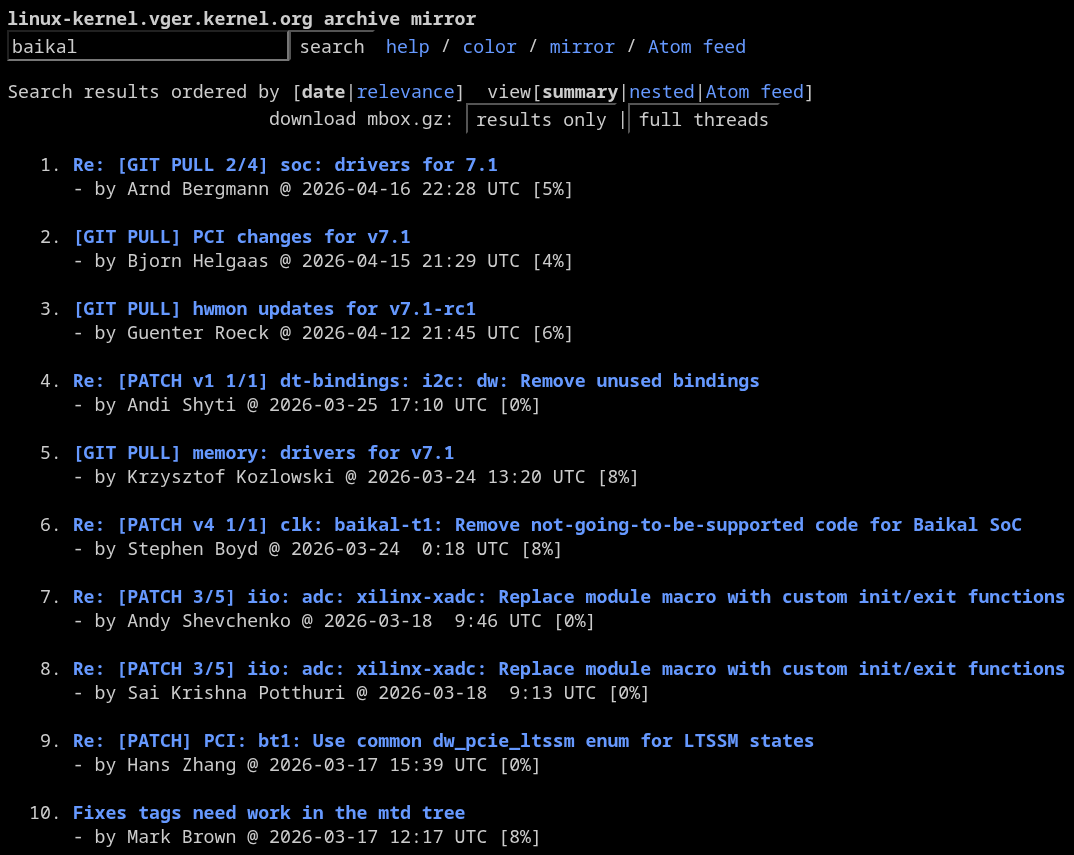
Furthermore, the code had been sitting unmaintained for some time now. Serge Semin, who contributed the bulk of Baikal's kernel support over the years, was among roughly a dozen Russian developers removed from the kernel MAINTAINERS file in 2024.
With no one left to maintain it and the hardware itself rare even within Russia, there appears to be no rationale for keeping the code around.
Some background info
The Baikal line of CPUs is the work of Baikal Electronics, which was founded in January 2012 as a spinoff of T-Platforms, a Russian supercomputer company.
It started with a MIPS-based chip for embedded applications, then pivoted to ARM for its later processors, all manufactured at TSMC. The plan was to supply Russian state-owned enterprises with domestically produced CPUs as an alternative to Intel and AMD.
But Russia's 2022 invasion of Ukraine ended that. Sanctions cut off TSMC access, 150,000 Baikal-M units already manufactured were seized in Taiwan, and ARM production licenses were lost. The company filed for bankruptcy in August 2023.
It did not stay down. By the end of 2024, Baikal had shipped a total of 85,000 processors since its founding and began serial production of the Baikal-U1000, a RISC-V microcontroller, in September 2025 (in Russian).
The current lineup consists of the Baikal-T (MIPS), Baikal-M and Baikal-S (ARM), and the Baikal-U (RISC-V).
Those already running Linux on Baikal hardware will need to stay on Linux 6.18 LTS or earlier, as newer kernel versions are dropping the support.
Suggested Read 📖: The Linux Kernel is Finally Letting Go of i486 CPU Support
 Sourav Rudra
Enjoyed this update? Support independent Linux news coverage
It's FOSS has been helping people use Linux for the past 14 years. Help us stay independent from big tech. Become a Plus member, enjoy ad-free reading and get 5 eBooks.