


- A 9-year-old bug was discovered recently.
- The vulnerability is already patched in the Linux kernel.
- Normal users could gain root access by running a small Python script.
- Not much of a bother for regular desktop Linux users who keep their systems updated.
- Could be problematic for cloud servers and containers if the kernel is not updated.
A logic flaw that sat quietly in the Linux kernel since 2017 has finally been found and disclosed. For a brief window, it let any unprivileged local user on a Linux system escalate to root with a script smaller than most config files.
The flaw is in a kernel subsystem that lets regular programs tap into built-in cryptographic functions. By feeding it file data in a specific way, an attacker can get the kernel to quietly overwrite 4 bytes of any file's in-memory copy.
The actual file on disk stays intact the whole time, so any tool checking file integrity will see nothing wrong. The exploit is just a 732-byte Python script that doesn't require any additional dependencies or compilation.
The vulnerability is tracked as CVE-2026-31431, goes by the name "Copy Fail," and was discovered by researchers at Theori using their AI security research tool, Xint Code.
The security researchers tested it on Ubuntu 24.04 LTS, Amazon Linux 2023, RHEL 10.1, and SUSE 16, getting root on all four with the exact same script each time.
They had reported the issue to the Linux kernel security team on March 23, received acknowledgment the next day, and had a patch proposed and reviewed by March 25. The fix was committed to mainline on April 1, with the CVE assigned on April 22, and public disclosure following on April 29 (linked earlier).
Who needs to worry, and who doesn't?
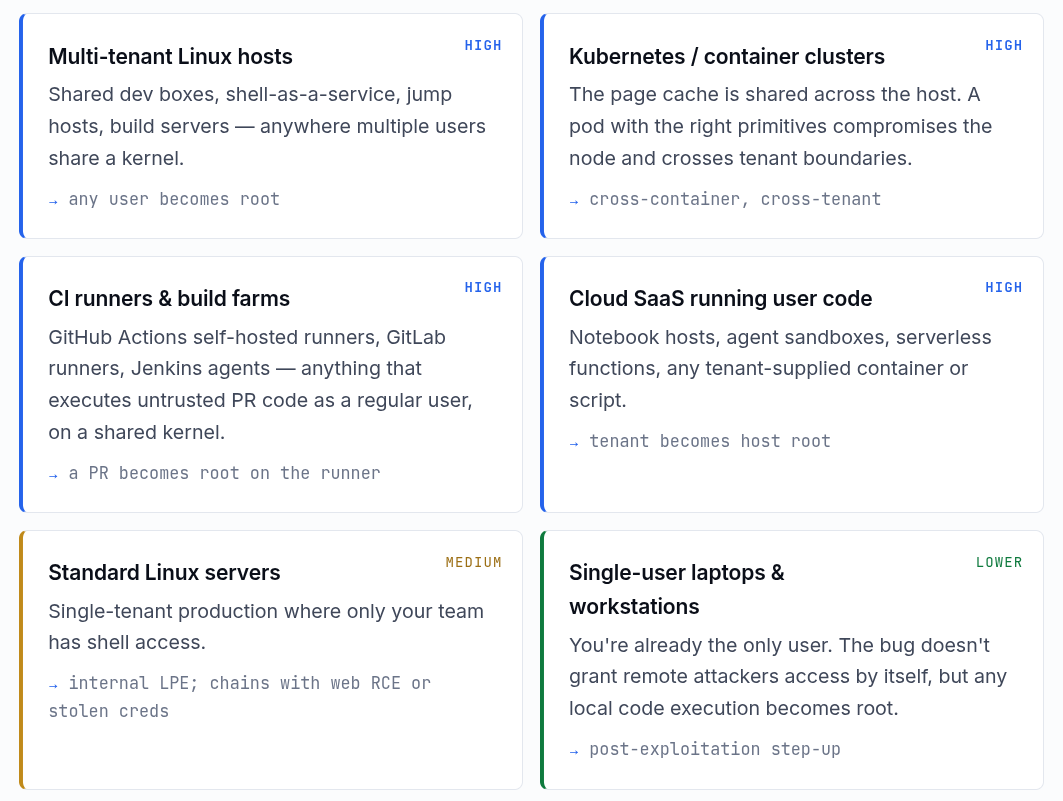
According to the Copy Fail website hosted by Theori, the risk level varies quite a bit depending on how you run Linux.
At the top are multi-tenant Linux hosts, Kubernetes and container clusters, CI runners and build farms, and cloud SaaS environments running user-supplied code.
These all get a "High" risk rating. Containers and cloud workloads are especially exposed because the Linux page cache, the part of memory this exploit corrupts, is shared across the entire host, container boundaries included.
A compromised container can take down the whole node, and a bad pull request run on a shared CI runner could hand an attacker root on that machine.
Standard Linux servers where only the team running it has shell access get a "Medium" rating, whereas personal desktops and laptops are at the bottom with a "Lower" risk rating.
Copy Fail needs local code execution to work, so it won't get anyone in remotely by itself. If malware is already running on your machine, this could be used to escalate to root, but that's a bigger problem either way.
To fix this, patching the kernel is the way. Most major distros have updates out or on the way. If patching isn't immediately possible, Theori recommends blacklisting the algif_aead kernel module as a stopgap:
echo "install algif_aead /bin/false" > /etc/modprobe.d/disable-algif-aead.conf

rmmod algif_aead 2>/dev/null
As of writing, Microsoft has noted that exploitation remained "limited and primarily observed in proof-of-concept testing," so there's no confirmed mass-scale campaign just yet.
That said, CISA, the US cybersecurity agency, has added Copy Fail to its Known Exploited Vulnerabilities (KEV) catalog, ordering US federal agencies to patch their Linux systems by May 15.
It also urged other organizations to treat it as a priority regardless of whether the federal deadline applies to them.
Suggested Read 📖: VS Code Was Adding Copilot as a Git Co-Author Without Telling Anyone
 Sourav Rudra
Enjoyed this update? Support independent Linux news coverage
It's FOSS has been helping people use Linux for the past 14 years. Help us stay independent from big tech. Become a Plus member, enjoy ad-free reading and get 5 eBooks.
Skip the AI slop and SEO spam in your Google results
Tell Google you prefer It's FOSS, and it will show our Linux news and tutorials, created by experienced Linux users, more often when you search. It takes just a click.
Set as preferred sourceGet FOSS Weekly in your inbox