


If you have been warming up to the idea of owning physical media or preserving your existing collection before it fades away, then PicoIDE should interest you.
The work of Polpotronics, this is an open source IDE/ATAPI emulator meant to replace aging tech like CD-ROM drives and hard disks. If you don't know what those are, you probably weren't around back then. ☠️
The job of the PicoIDE is quite simple; it can take in disk images (e.g., ISO, .bin/.cue, .vhd) from microSD cards and present them to your vintage computer as real IDE hard drives or ATAPI CD-ROM drives.
PicoIDE: Physical Media FTW
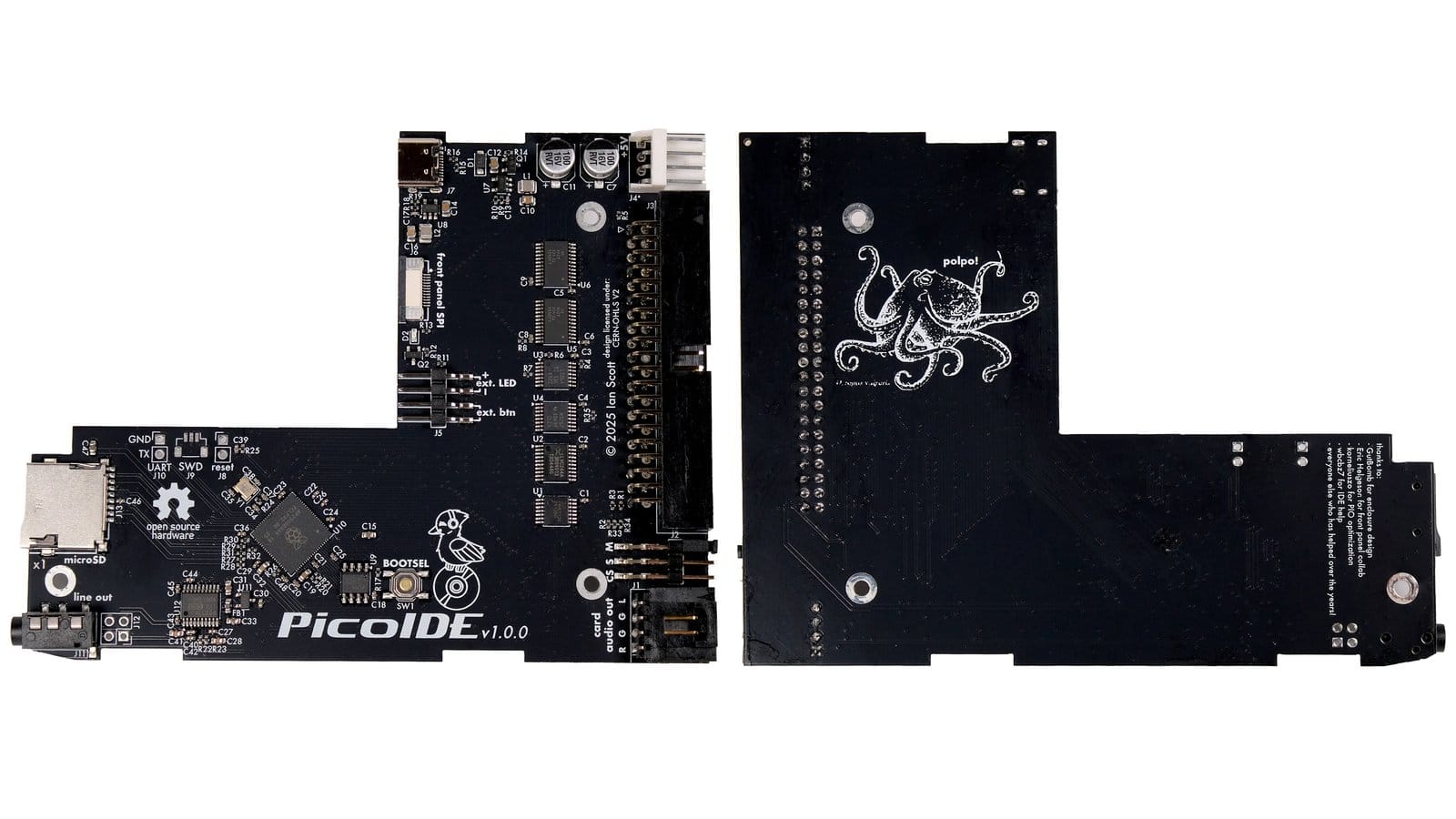
The PicoIDE is powered by a Raspberry Pi RP2350 microcontroller and fits into a standard 3.5-inch drive bay found on most old hardware. It uses a regular 40-pin IDE connector and gets power through the standard 4-pin Molex connector.
For storage, it reads disk images off microSD cards formatted in FAT32 or exFAT. There are two variants for it; the Base one handles image switching through a DOS utility or by swapping the microSD card.
The Deluxe version adds an OLED display and physical buttons so you can browse and switch images directly on the device. It also has WiFi for managing images through a web interface.
The device supports PIO modes 0-4 and multi-word DMA modes 0-2 for data transfer. It also has a proper audio setup with a TI PCM5100A DAC that outputs high quality analog CD audio through both an MPC-2 header and a 3.5mm line-out jack.
You can also create or modify disk images using emulators like 86Box or WinUAE (the name is unrelated to a certain soulless regime).
As for why anyone would need such a device, the Crowdsupply page for the project gives a fine example. Load your entire CD game library onto one microSD card, organize it, and switch between titles using the front panel or DOS utility.
The CD audio output even works with mixed-mode discs that have redbook audio tracks, which software emulators can't handle, they add.
💰 Funding the PicoIDE
As of writing this, the PicoIDE had reached its funding goal of $35,000 and was going strong at $100,339 raised.
If you want to get your hands on it, then you can pitch in a minimum of $69 for the Base variant, which gets you a fully assembled PicoIDE board along with its enclosure.
If you can go the extra mile, then $110 gets you the Deluxe variant, which is the same thing but with two color options and more bits, as mentioned earlier.
You should also keep an eye on PicoIDE's GitHub repo. The design files and source code will go live there before units start shipping.
Suggested Read 📖: These Linux Distros Turn Your PC into a Retro Gaming Console
 Abhishek Prakash