


As AI, automation, and cloud technologies transform the tech landscape, most of us Linux users wonder whether system administration is still a stable and future-proof career path.
To get clarity from someone working directly with modern IT teams, I discussed with Hirdaypal Singh Lamba, a Salesforce Consultant on the Jobtrees team who regularly collaborates with system administrators across different environments.
This email conversation highlighted how the role has changed, what skills are becoming essential, and how aspiring IT professionals can stay competitive in a rapidly evolving field.
How the sysadmin role has changed
When I asked Hirday to describe how traditional system administrators used to work, he painted a clear picture.
In the past, a system administrator was like a mechanic for a company’s computer systems who would manually fix servers when they broke and kept the digital infrastructure running.
Sysadmins were deeply hands-on. They repaired physical servers, troubleshot networks, and maintained hardware that sat in on-premise data centers. Their daily work revolved around manual tasks and repeatable processes.
But as Hirday explained, that world looks very different today.
Automation, cloud, and AI now drive the role
We discussed how cloud infrastructure and AI tools have shifted the role dramatically. Modern systems are virtual, distributed, automated, and monitored by intelligent software rather than human intervention.
Hirday described this shift clearly.
Much of the repetitive, manual work is now handled by code and automated processes.
Instead of physically handling hardware, sysadmins now manage virtual systems, write scripts, and work with cloud platforms. This requires a different mindset and a broader technical toolkit than previous generations of the role.
Sysadmins and DevOps are closer than ever
I asked Hirday whether system administrators today resemble DevOps engineers, and his answer was something I had expected.
The modern sysadmin's job has shifted from physically managing machines to writing scripts and using new tools to manage virtual systems, making their role look a lot more like a DevOps engineer.
We talked about the skills companies now expect from sysadmins, including cloud technologies, scripting languages, automation tools, and AI-integrated monitoring systems. The line between sysadmin and DevOps continues to blur, and many professionals now build hybrid skill sets that span both areas.
Is Sysadmin still a good career choice?
That's the burning question we all want to know. Is system administration still a promising career path? Hriday emphasized adaptability.
Being a sysadmin is still a good career choice, but only if you adapt to these new demands. The old fashioned sysadmin who doesn’t code or use AI is becoming obsolete. The future proof sysadmin is one who embraces AI, learns scripting, and understands cloud technologies.
System administration remains relevant, but the expectations have shifted. Success now depends on a willingness to learn automation, cloud platforms, and emerging tools.
Advice for aspiring IT professionals
To close our conversation, I asked Hirday what he would recommend to someone starting in the field today.
The best path forward for an aspiring IT professional is to learn the fundamentals of system administration and then build DevOps skills on top of that foundation to stay relevant in today’s tech landscape.
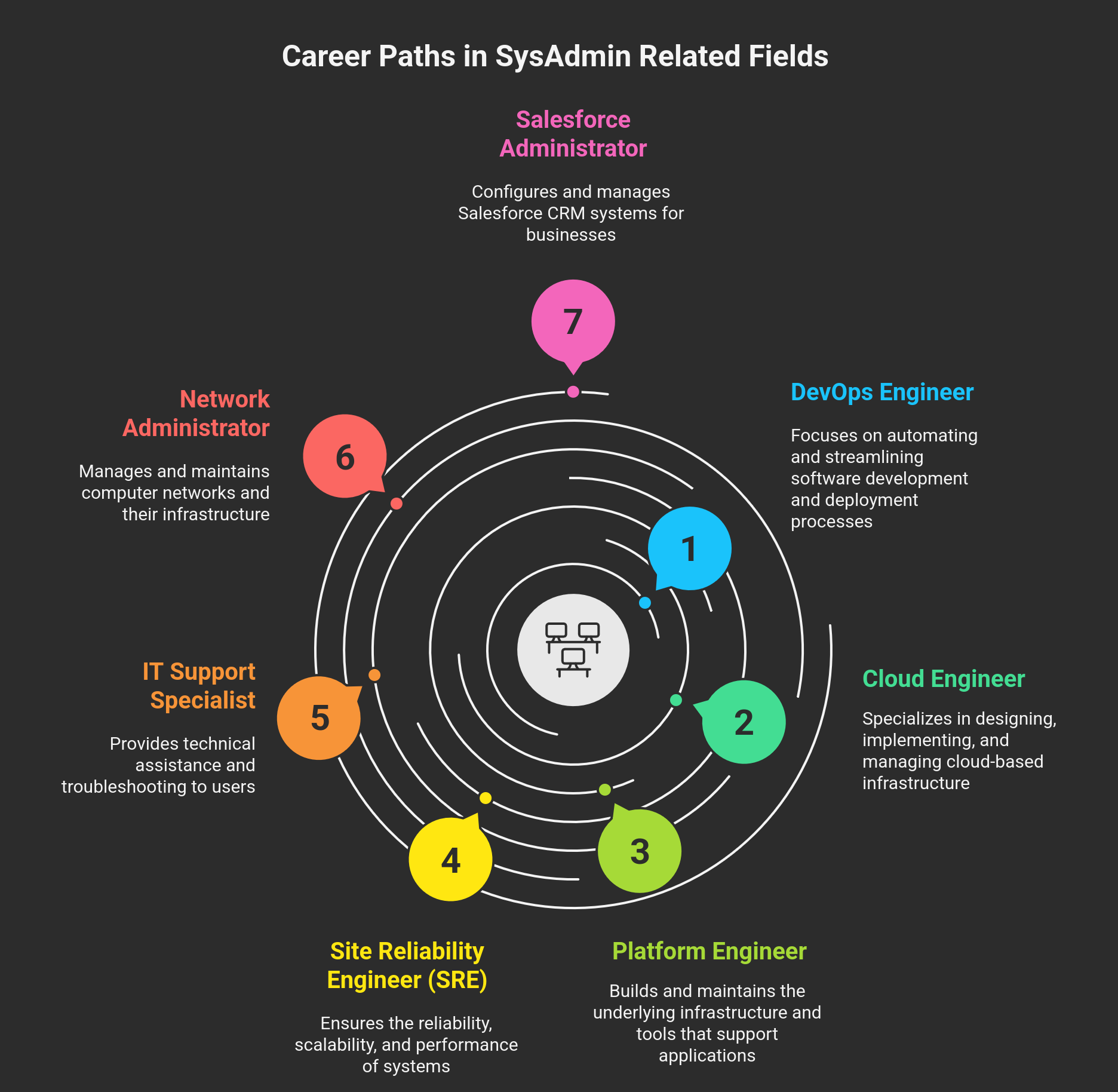
This layered approach strengthens both core understanding and modern technical flexibility, opening doors to multiple high-growth career paths:
- DevOps Engineer
- Cloud Engineer
- Platform Engineer
- Site Reliability Engineer (SRE)
- IT Support Specialist
- Network Administrator
- Salesforce Administrator
The traditional sysadmin role is not dead but has evolved. To stay relevant, learn the core knowledge of sysadmin but then add devops skills on top of it. Don't detest AI, even as an end user. Consider it another addition to your toolbox.