

Founded by engineers in Tunisia, dawndrums is a young company working on open mobile systems. Their Divine D. smartphone project recently got a significant hardware update with the Rev 1.1 board design.
The outfit is headed by Dr.-Ing. Sadok Bdiri, with the ambitious goal of building an open source project that empowers people and communities to take back control of technology.
They also recently shared a video showing DawnOS booting successfully on a working Divine D. prototype.
Divine D. is On The Horizon
Being built as part of the Divine project, the Divine D. is a Linux smartphone running DawnOS. The operating system is built on Mobian and Debian, with Phosh serving as the desktop user interface.
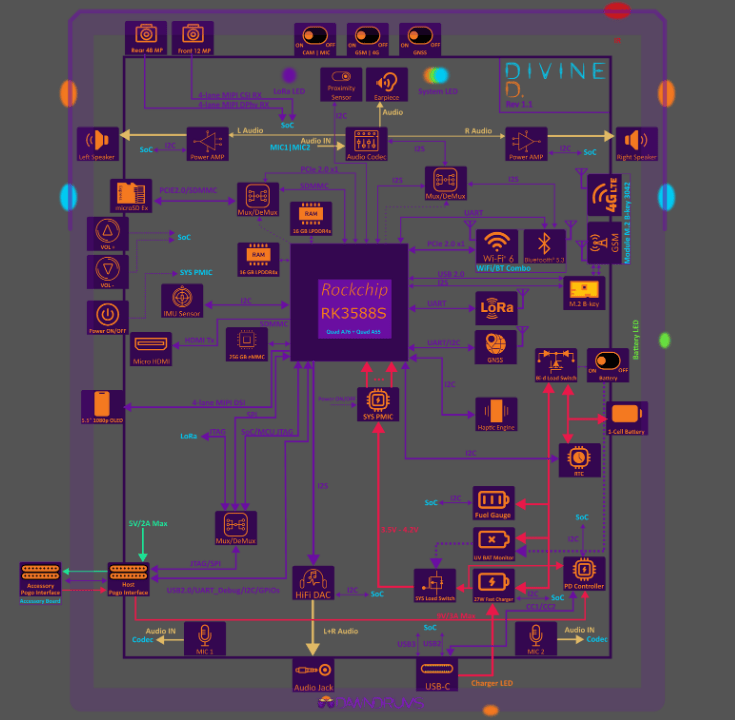
The hardware has a Rockchip RK3588S processor at its heart, with 4x Cortex-A76 cores running at 2.4 GHz and 4x Cortex-A55 cores running at 1.8 GHz. Graphics duties are handled by an Arm Mali-G610 GPU.
The device features a three-core NPU that delivers 6 TFLOPS of processing power. This allows running language models locally without sending data to external servers. RAM goes up to 32 GB of LPDDR4x memory with storage options of 64 GB, 128 GB, or 256 GB via eMMC.
The Divine D. also includes physical kill switches for the cameras, microphones, and cellular modem. These are hardware-level switches that physically cut power to those components.
In terms of ports and expansion, the Divine D. offers a lot:
- LoRa module for long-range, low-power communication (think: mesh networks and off-grid messaging).
- Micro HDMI 2.1 port with support for 8K video output at 60Hz.
- MicroSD Express slot with PCIe 2.0 interface offering speeds of up to 500 MB/s (backward compatible with regular microSD).
- M.2 B-key connector for 4G/GSM modules to enable mobile network connectivity.
- 18-pin pogo interface that exposes GPIO, SPI, UART, I2C, and JTAG for additional peripheral support.
- Haptic engine with motor and driver for vibrations, alerts, and reacting dynamically to the user interface.
- Multiple LED indicators for system status, charging state, battery monitoring, and LoRa connectivity.
Want Your Own Divine D.?
There is no information on pricing or shipping timelines yet. The project is still in active development, with the team sharing updates on their documentation page, forum, and Discord server.
Their GitHub page hosts the software repositories under GPL-3.0 licensing, but the availability of hardware design files remains a mystery at this point.
Via: Liliputing
Suggested Read 📖
 Sourav Rudra