


The US states of California, Colorado and Illinois are passing new age verification laws that require operating systems, including Linux and BSD distributions, to implement age attestation during account setup and provide an API for apps to query user age brackets.
This is 'intended to help' apps filter content for minors, but it relies on self-reported ages without mandatory ID checks. Similar proposals exist in New York and Brazil.
While enforcement on community-driven distros remains unclear, several have begun addressing the laws through compliance planning, rejection, or exclusion strategies.
Here's the situation so far.
Some distros are planning to comply
Canonical, the company behind Ubuntu, is reviewing the legislation with legal counsel but has not announced concrete changes yet. Community developer discussions include proposals for an optional D-Bus interface (org.freedesktop.AgeVerification1) to handle age brackets locally without privacy-invasive telemetry, potentially influencing other distros if adopted.
Aaron Rainbolt, Ubuntu Community Council Member and contributor to Whonix, said:
We're currently looking into how to implement an API that will comply with the laws while also not being a privacy disaster...
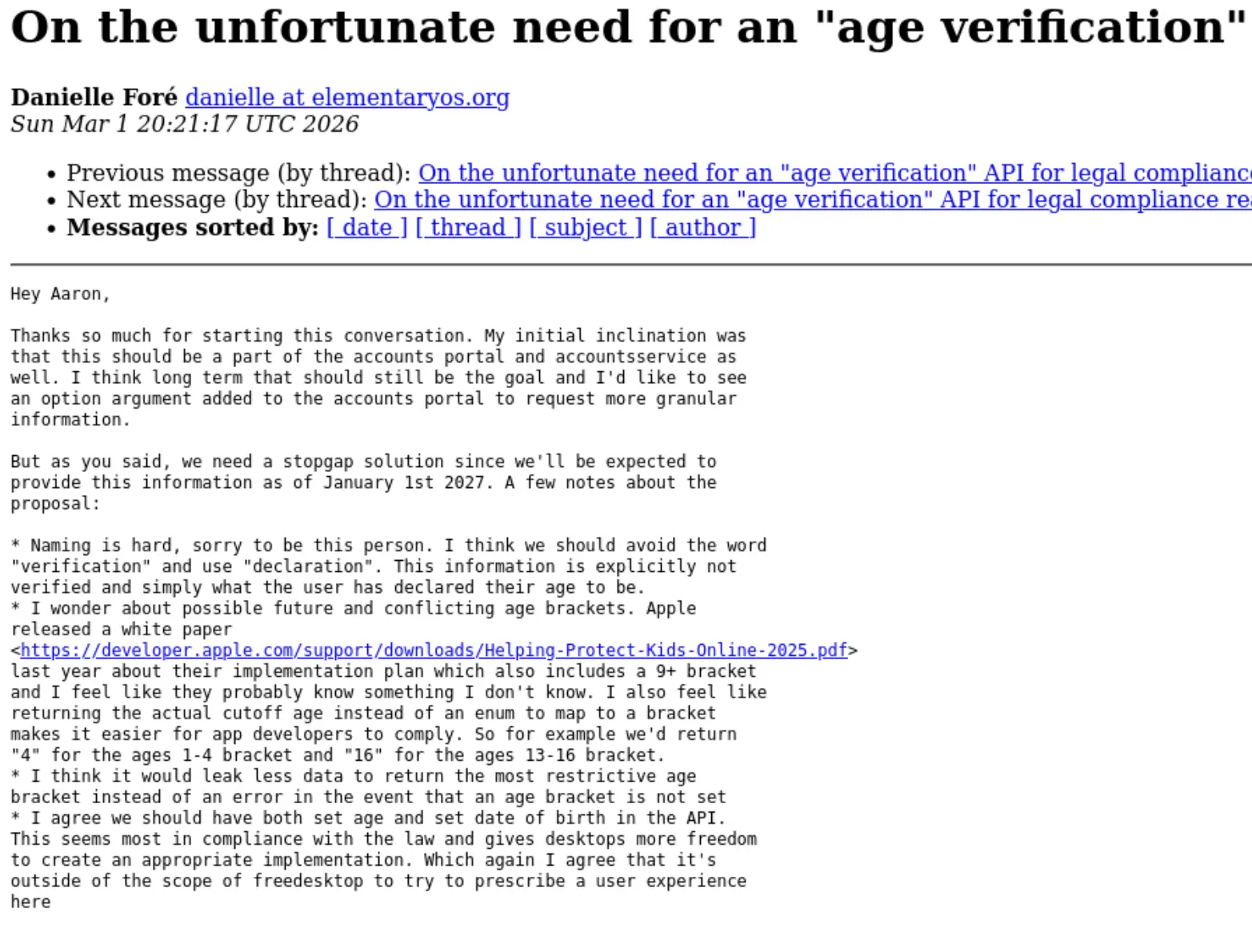
elementary OS seems to be relying on Ubuntu's implementation too. Danielle Foré, elementary's lead developer and founder, was also in the same discussion expressing their willingness to address the issue before the law comes into effect.
The Fedora community is exploring non-intrusive implementations, such as a local API or an /etc/ file populated during setup to provide age brackets to apps without online verification or data sharing. Former project leader Jef Spaleta mentioned that it is not telemetry but a minimal adjustment to meet legal requirements.

System76, Linux system manufacturer and the company behind Pop!OS, noted that the laws do not mandate robust verification, only self-attestation and warned that non-compliance could lead to restricted app access for users. They are also considering minimal changes to provide age signals, focusing on avoiding unintended consequences like a "nerfed internet."
If there is any solace in these two laws, it’s that they don’t have any real restrictions. There is no actual age verification. Whoever installed the operating system or created the account simply says what age they are. They can lie. They will lie. They’re being encouraged to lie for fear of being restricted to a nerfed internet.
Some distros are resisting
The bold step came from DHH and his Omarchy Linux as it outright rejected compliance, with DHH stating that he had no plans to respond to the "retarded" California law.
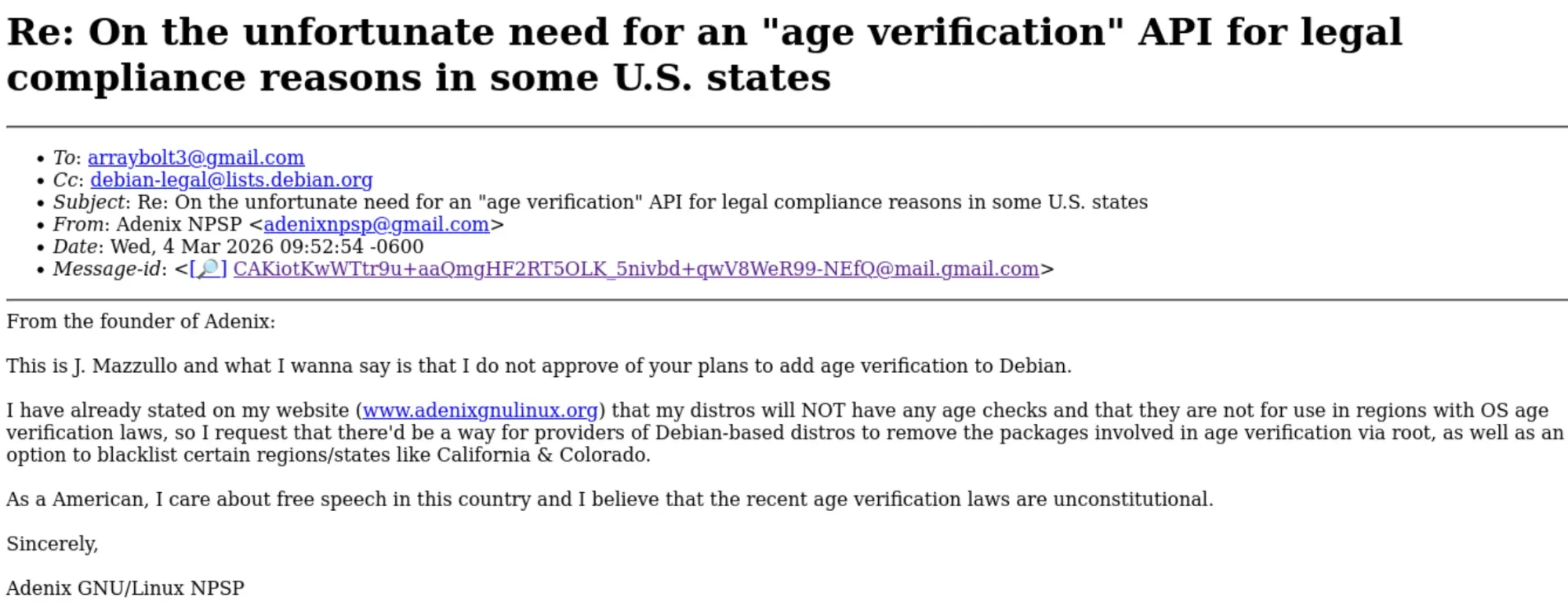
Adenix GNU/Linux distro has declared it will not implement age checks, aligning with a principled stand against such requirements.
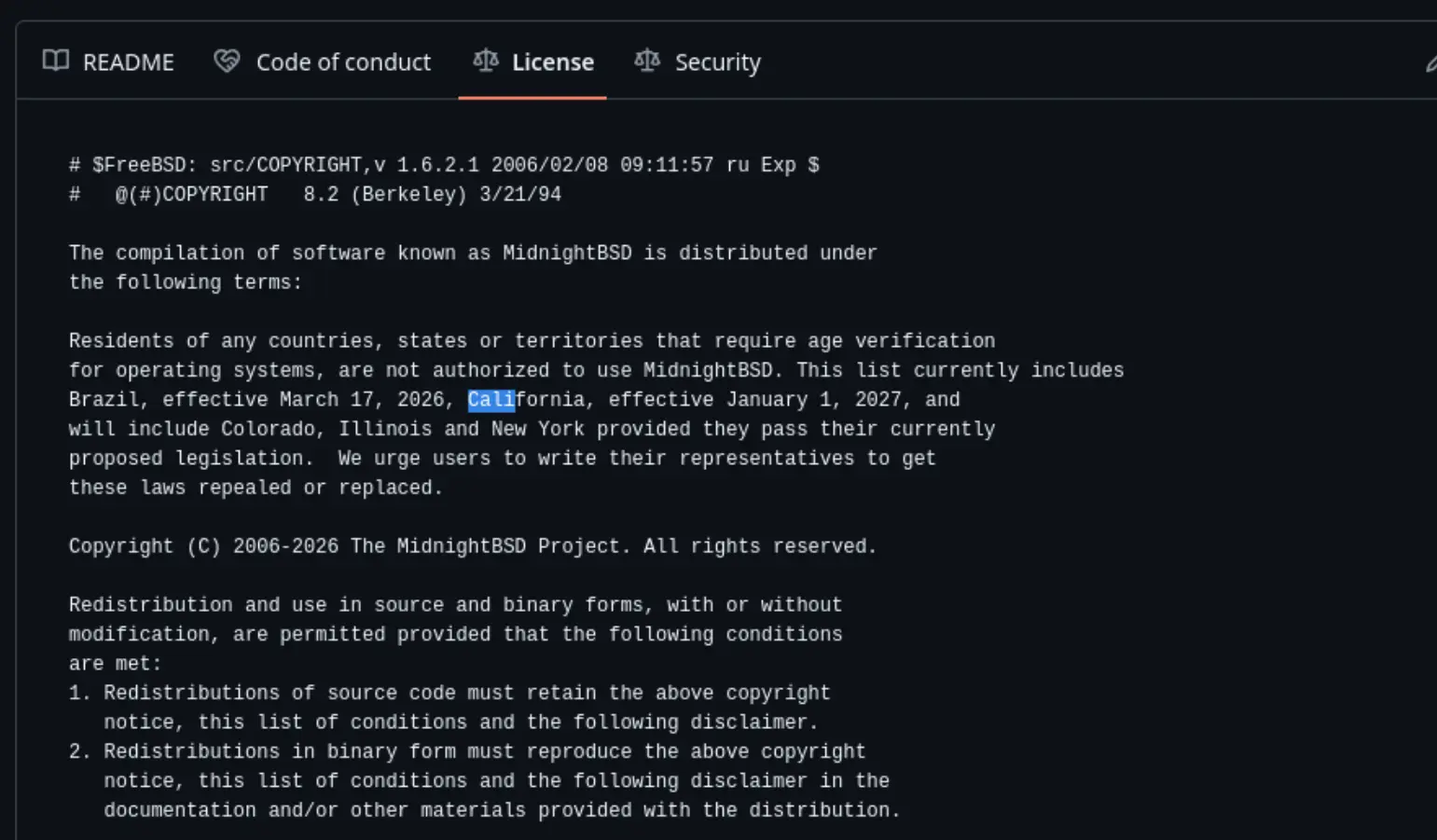
MidnightBSD has taken a firm stance against compliance by updating its license to explicitly exclude California residents from using it for desktop purposes starting January 1, 2027. The project's lead stated this is a temporary measure until a better solution emerges, emphasizing the impracticality of age verification for open-source OSes.
What about the rest?
There are no official statements from Linux Mint yet, so any conclusion here is merely speculative. Given its close alignment with Ubuntu, I think it will follow whatever direction Ubuntu takes, possibly adopting the same shared API approach.
Arch Linux has remained publicly silent on the issue as well. Some forum discussions briefly appeared in my web search results but they seem to be removed, leaving no clear indication of the project’s stance. SUSE has also not made any public comments so far. Since the legislation originates in the U.S., European-focused distributions like SUSE may not feel immediate pressure to respond.
Meanwhile, discussions in the NixOS community suggest that they are waiting to see what larger distributions decide. That is not surprising. Much of the Linux ecosystem ultimately traces back to Debian, Arch, Ubuntu, and Red Hat (Fedora). Whatever technical approach these major players adopt will likely influence dozens of downstream distributions.
And we should also see a few existing or new distros coming up with "no age verification" as their unique feature that distinguishes them from the rest. After all, Linux community is known to take a stance, right?